Download
1 / 2
20 likes | 126 Vues
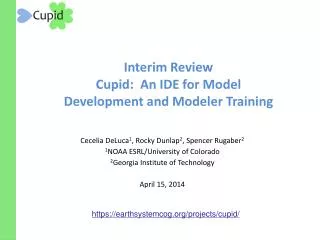
CUPID is an innovative Integrated Development Environment (IDE) designed for Earth System Model development and training, balancing expert flexibility and novice accessibility. Built on the Eclipse Modeling Framework with a domain-specific language derived from the Earth System Modeling Framework (ESMF), CUPID enables users to change and test source models with task automation and guidance. Our project explores integration with various tools and aims to create a modular, flexible, and interoperable platform that enhances the development environment for teachers, students, and researchers in the field.

E N D
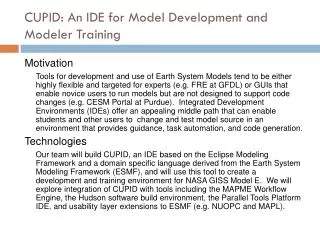
CUPID: An IDE for Model Development and Modeler Training Motivation Tools for development and use of Earth System Models tend to be either highly flexible and targeted for experts (e.g. FRE at GFDL) or GUIs that enable novice users to run models but are not designed to support code changes (e.g. CESM Portal at Purdue). Integrated Development Environments (IDEs) offer an appealing middle path that can enable students and other users to change and test model source in an environment that provides guidance, task automation, and code generation. Technologies Our team will build CUPID, an IDE based on the Eclipse Modeling Framework and a domain specific language derived from the Earth System Modeling Framework (ESMF), and will use this tool to create a development and training environment for NASA GISS Model E. We will explore integration of CUPID with tools including the MAPME Workflow Engine, the Hudson software build environment, the Parallel Tools Platform IDE, and usability layer extensions to ESMF (e.g. NUOPC and MAPL).
CUPID: An IDE for Model Development and Modeler Training Development Paths • Development and deployment of CUPID • Adaptation of GISS Model E for ESMF • Integration of CUPID with reworked Model E Team • Georgia Institute of Technology (Dunlap/Mark/Rugaber) • University of Colorado/CIRES (DeLuca) • NASA Software Systems Support Office (Clune) • NASA GISS (Schmidt) Impacts • More modular, flexible, interoperable, and extensible version of Model E • Development environment for Model E for students, new users, and scientists/programmers • Demonstration of IDE viability for the ESM community • Extensible platform for other models (e.g. GEOS) to adopt