Enhancing Water Governance and Financing in Irrigation Reforms
60 likes | 174 Vues
This paper discusses critical issues around irrigation financing and governance, highlighting the role of donors and the private sector in promoting sustainable practices. It emphasizes the need for a legal enabling framework for effective irrigation reforms and analyzes the political economy of change in this sector. The document also addresses significant challenges such as corruption in large-scale systems and the impact of environmental lobbies. The potential institutional landscape post-reform and innovative financing strategies, including insights from China's practices, are explored further in the context of irrigation management and agricultural sustainability.


Enhancing Water Governance and Financing in Irrigation Reforms
E N D
Presentation Transcript
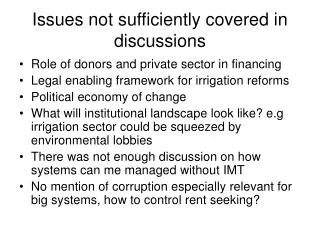
Issues not sufficiently covered in discussions • Role of donors and private sector in financing • Legal enabling framework for irrigation reforms • Political economy of change • What will institutional landscape look like? e.g irrigation sector could be squeezed by environmental lobbies • There was not enough discussion on how systems can me managed without IMT • No mention of corruption especially relevant for big systems, how to control rent seeking?
Dealing with corruption leads to reduction in capital costs • Include corruption and similar issues within the broader framework of water governance • Emphasize on water governance • Any idea on how to update the irrigation investment data? • Issued bonds for construction of projects through state owned irrigation corporation
In China, government investment is pre dominant, though farmers and companies also invest. • In China, last year central government increased investments by 20% and at the same time set up a committee to oversee spending...it helped curbed corruption? • Financing point of view, New Zealand experiment with selling off irrigation assets • Private GW investments higher than or almost equal to public SW in India
Institutional reforms are as important as ever • Asian countries looking for support from ADB for irrigation sector, so declining interest in agriculture/irrigation from ADB is a concern. • Irrigation serving agriculture, so consider irrigation goes beyond infrastructure • Making the Executive Summary attractive to lay public
Not enough case studies on management reforms in the Issue Paper
Knowledge Hub: IWMI and FAO are partners, knowledge products and capacity building programs at FAO. • ICID view: Knowledge hub would be very useful for irrigation professionals, links with knowledge hub website • China: ICID President met Chinese water water minister and they are interested in the knowledge hub. • Role of knowledge hub on strategies for their donor countries • Capacity building services from the knowledge hub • Use share point on the K Hub to share the issue paper