Download
1 / 6
60 likes | 209 Vues
This presentation by Piers Larcombe addresses the critical knowledge gaps in sediment transport in the North West of Australia, focusing on ecological and developmental implications. The region's ecological value is highlighted, alongside its vulnerability to cyclones and major dredging projects. By investigating sediment transport pathways over decades to centuries, the study aims to improve environmental management, project design, and regulatory assessments. Key insights on bedforms, spatial gradients, and in-situ sediment production rates are discussed to support effective marine developments.

E N D
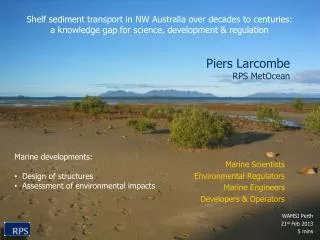
Shelf sediment transport in NW Australia over decades to centuries: a knowledge gap for science, development & regulation Piers LarcombeRPS MetOcean • Marine developments: • Design of structures • Assessment of environmental impacts Marine Scientists Environmental Regulators Marine Engineers Developers & Operators WAMSI Perth 21st Feb 2013 5 mins
NW Australia has: much of ecological value Key ecological features represented in the North-west Commonwealth Marine Reserves Network
Belderson et al. (1982) NW Australia will have: bed sediment transport pathways • Scales = relevant to developments • >decades • 10s-100s km • Ecology = f (sedimentology) • Engineering = f (sedimentology) • (NB – this is not transport AT the coast)
NW Australia has: major development projects 8 proposals requiring ‘substantial’ dredging Total ~200 M m3 Pilbara / W. Kimberley Dredged channels, up to >30 km long Durations >many decades Dredging volume >150 M m3 WA EPA (Oct. 2012)
NW Australia has: …knowledge gaps that WAMSI can help fillto enhance: environmental management & project design • Shelf Sedimentary Research • To define the pathways’ location and extent • e.g. Where are the critical regions? • Wrt removal (dredging) and addition (disposal) of sediment • At EIA stage - Improve assessment of pathways • Many aspects, but esp. testing of directions • Bedforms, Deposits, Spatial gradients • Assess in-situ sediment production rates (biogenic sediment)