Galaxies
This engaging overview of the Milky Way galaxy delves into crucial astronomical concepts like distance measurement in space. Learn about the astronomical unit (AU) and how it helps define the vast distances between celestial bodies, including the Earth and the Sun. Discover the classification of galaxies, featuring elliptical, spiral, and irregular types, along with iconic examples like ESO 325-G004, Messier 101, and NGC 1427A. The Milky Way itself spans 100,000 light-years in diameter and contains an estimated 200 to 400 billion stars, painting a dazzling portrait of our galactic home.

Galaxies
E N D
Presentation Transcript
Galaxies Milky Way…….More than just a candy bar! p. 234 or WB 149
Distance Measurement in Space • No miles. Too small. • Astronomical Unit • Average distance bt. Earth and Sun. (93 million miles)
Light • YouTube Clip • 1AU=8.3 light min. • We use this to measure distance. • light year-outside S.S. • light minute or second-inside S.S.
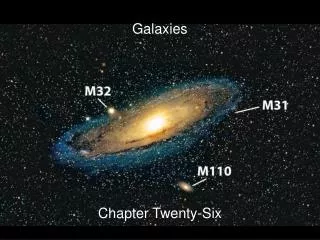
What is a galaxy? • A galaxy is a group of stars, gas, and dust that are held together by gravity.
Edwin Hubble • Began to classify galaxies in the 1920s. • The Hubble Space Telescope is named after him.
1.Elliptical 2.Spiral 3.Irregular Types of galaxies
Elliptical Galaxy • Many look like a giant sphere or a star football. • 1/3 of all galaxies are elliptical. • They have very bright centers. • This one is called ESO 325-G004.
Spiral Galaxy • These look like a pinwheel. • They have a bulge in the center and spiral arms. • This one is called Messier 101 or NGC 5457.
Irregular Galaxy • When Hubble began to classify galaxies he had a group of leftovers. • They were called Irregulars. • This one is called NGC1427A.
Our Galaxy: The Milky Way! • 100,000 light years in diameter and 1,000 light years thick. • Anywhere from 200 billion to 400 billion stars. • Galaxy = 80 miles • Earth = .08 inches