Download

1 / 21
210 likes | 323 Vues
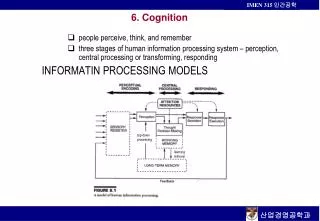
This document explores the fundamental principles of cognition, focusing on information processing models related to selective attention and perception. It discusses working memory, highlighting its limits, capacity, and strategies for minimizing cognitive load. Long-term memory mechanisms, including schemas and cognitive maps, are also examined. Practical implications for design are provided, emphasizing the importance of organization and memory aids. The role of situation awareness in problem-solving, planning, and managing mental effort is addressed, offering insights into optimizing cognitive performance in various contexts.

E N D
Three Perceptual Processes • Human Factors Guidelines
A Model of Working Memory • Limits of Working Memory • Capacity • Time • Confusability and Similarity • Attention and Similarity
HF Implications of WM Limits • Minimize working memory load • Provide visual echoes • Provide placeholders for sequential tasks • Exploit chunking • Minimize confusability • Avoid unnecessary zeros in codes to be remembered • Consider WM limits in instructions
Basic Mechanisms • Strength • Associations • WM and LTM • Forgetting
Organization of Info in LTM • Schemas and Scripts • Mental Models • Cognitive Maps • LTM Implications for Design • Episodic Memory for Events • Prospective Memory for Future Events
Mental Effort and Resource Demand • Structural Similarity • Confusion • Task Management and Interruptions • Addressing Time-Sharing Overload