Society in Iran (post-revolution)
210 likes | 465 Vues
Society in Iran (post-revolution). By: Lexi Williams, Eden Wenokur, Jennifer Dang, Kelsie Morehead, Isaiah Hannafious, and Kyle Weber. Religion. Religion is extremely important to Iran. Islam is the official religion of Iran.


Society in Iran (post-revolution)
E N D
Presentation Transcript
Society in Iran (post-revolution) • By: Lexi Williams, Eden Wenokur, Jennifer Dang, Kelsie Morehead, Isaiah Hannafious, and Kyle Weber
Religion • Religion is extremely important to Iran. • Islam is the official religion of Iran. • Other religions include, Zoroastrian, Jewish, Christian, and Bahia. • Fundamental beliefs of Muslims- the “oneness” of Allah (God), that Muhammad is the last prophet, prayer, fasting, and the pilgrimage to Mecca. • Iranian revolt of 1979 left most of Iran as Shia.
Within Islam • Shia and Sunni are two branches of Islam. • Reason for split is the idea of who would have had leadership after Muhammad’s death • Differences in doctrine, ritual, law, theology, and religious organization. • Constantly at odds.
Shia and Sunni • Sunni regard themselves as the more traditional branch of Islam • Shia sees them selves as discriminated against. • Sunni are the largest branch of Islam. • Only about 10% of Muslims are Shia. • Sunni means” well-trodden path" or "tradition” • Shia means "party" or "partisans" of Ali
Role of Women in Society • Men are more powerful than women and practically own them as items • In court, the women aren't worth as much as men are and are not taken as seriously • Women are looked down upon
Role of Women in Society • In Iran the gender discrimination is still going strong, segregation is still happening. On the buses women have to sit in the back of the bus by law • Women are still battling for equal rights • Women cannot receive a passport unless her husband or some other male relative gives her permission to
Health • Women and men have segregated hospitals • Women’s health is actually controlled by their husband or their father, especially in families where the men are in power • Women usually only have free care access to programs that help them maternally and with birth care
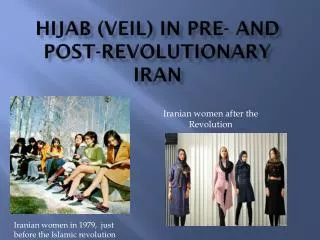
Clothing • Usually, a chador is worn to cover all skin and hair of a Muslim woman, the hands and face being acceptable. • Some women who don’t have strict requirements about it do not wear a chador, but instead a veil (hijab) is worn to cover their hair. The veil was worn to show rebellion to being “western” • The veil was also worn to show Islam's accession into Iran and the end to imperialism
Clothing • Showing skin and wearing regular clothing was seen to be too “sexy” and too “ western” • Eventually, the government tried to demand the women to cover themselves up with veils and/or chadors, but the women didn't take it easily because the women have always had a problem with equality.
Education • Education is very important • Islamization • Schools are segregated • After revolution, women’s education has improved and grown a lot, with higher enrollment
Education • 1 year pre-school (5 years old), • 5 years primary(6-10), • 3 years lower secondary(11-13), • 3 years upper secondary(14-17), • Vocational school or pre-university • University/other higher education
Higher Education • There are many universities, institutions, colleges • Vocational schools (such as teacher-training colleges) • There are private, public, state-run universities
The Family Unit • Family is very important • Father is the head of the family • Children in the family
Family Dynamics • Parental control • Extended family
Daughters and Sons • Double standards • Clothing choice
Government • Islamic Republic (Religion IS a part of the government) • The government takes breaks on religious holidays, and religion influences religious decisions.
Iranian Government Officials • Head of the Government: President Hasan Fereidun Ruhani (instated August 3rd, 2013) • Vice President: Mohammad Reza Rahimi (elected Sep. 13th 2009). • Supreme Leader (Chief of State): Ali Hoseini-Khamenei.
The Constitution of the Islamic Republic of Iran • Originally adopted in 1979, replacing the previous constitution, which was made in 1906. • The Constitution was last modified in 1989. • The Constitution’s section on government defines the roles of religion in government, as well as the role of democracy in religion.
Bibliography • "Iran Chamber Society: The Constitution of Islamic Republic of Iran." Iran Chamber Society: The Constitution of Islamic Republic of Iran. Iran Chamber Society, n.d. Web. 24 Sept. 2013 • "Government Profile: Iran." PBS. PBS, 8 Nov. 2005. Web. 24 Sept. 2013. • "Central Intelligence Agency." The World Factbook. CIA, 11 Sept. 2013. Web. 24 Sept. 2013 • BEEMAN, WILLIAM O. "Countries and Their Cultures." Culture of Iran. http://www.everyculture.com/Ge-It/Iran.html#b • Price, Massoume. "Culture of Iran. Patriarchy and Parental Control in Iran." Culture of Iran. Patriarchy and Parental Control in Iran. N.p., Oct. 2009 • Helen Chapin Metz, ed. Iran: A Country Study. Washington: GPO for the Library of Congress, 1987. • Kar, Mehrangiz. "Women, the Victims of the Iranian Revolution." A Forum on Human Rights and Democracy in Iran. 5 Mar. 2010. Gozaar. 24 Sept. 2013 <http://www.gozaar.org/english/articlesen/Women-the-Victims-of-the-Iranian-Revolution.html>. • Girgis, Monique. "Iran Chamber Society: Iranian Society: Women in pre-revolutionary, revolutionary and post-revolutionary Iran [Chapter Three]." Iran Chamber Society: Iranian Society: Women in pre-revolutionary, revolutionary and post-revolutionary Iran [Chapter Three]. Iran Chamber Society. 24 Sept. 2013 <http://www.iranchamber.com/society/articles/women_prepost_revolutionary_iran3.php>. • • "Women Pre and Post Iranian Revolution." SonjaBe.com. 13 Sept. 2011. Sonjabe.com. 24 Sept. 2013 <http://sonjabe.com/women-pre-and-post-iranian-revolution/%20>. • "Women in Iran." World Savvy Monitor. 8 Mar. 2009. World Savy Monitor. 24 Sept. 2013 <http://worldsavvy.org/monitor/index.php?option=com_content>.
Bibliography • "Iran Chamber Society: Education in Iran: The Iranian Educational System." Iran Chamber Society. N.p., 24 Sept. 2013. Web. 23 Sept. 2013. <http://www.iranchamber.com/education/articles/educational_system.php>. • "Education in Post-Revolutionary Iran." EWENR, Education in Post-Revolutionary Iran. Ed. Robert Sedgwick. World Education Services, n.d. Web. 24 Sept. 2013. <http://www.wes.org/ewenr/00may/practical.htm>. • "Educational Attainment in Iran | Middle East Institute." Middle East Institute. N.p., 29 Jan. 2009. Web. 24 Sept. 2013. <http://www.mei.edu/content/educational-attainment-iran>.