Understanding Human Tissues: Types, Functions, and Characteristics
Human tissues are classified into four main types: epithelial, connective, muscle, and nerve. Epithelial tissues cover body surfaces, protect organs, and facilitate absorption and secretion. Connective tissues support and bind other tissues while providing nourishment. Muscle tissues are responsible for movement, with skeletal, smooth, and cardiac varieties. Each tissue type has specific characteristics and functions, such as the stratified squamous epithelium providing protection or connective tissue types like cartilage and bone offering structure and support. Explore the diverse roles of tissues in maintaining body function.


Understanding Human Tissues: Types, Functions, and Characteristics
E N D
Presentation Transcript
Key words • “Epi”= upon • “Pseudo”= false • “Squam” = scale • “Strat”= layer • Simple- one layer • Stratified- multiple layers • Cuboidal- cube shaped • Columnar- rectangle shape- column • Squamous- flat shape
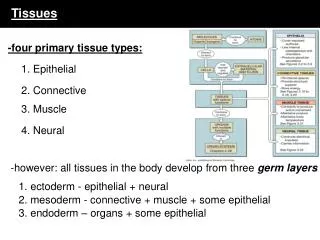
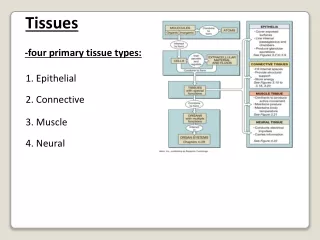
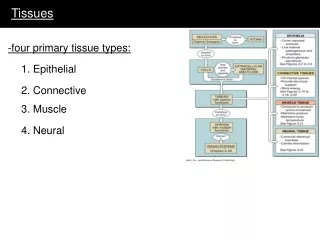
Tissues • * a group of cells with specialized functions • Types: • 1) Epithelial • 2) Connective • 3) Muscle • 4) Nerve
Epithelial Tissues • Covers all free body surfaces • Characteristics: • Lacks blood vessels, attached to a basement membrane, replaced continuously • Functions: protects, secretes, absorbs, excretes
Types of Epithelial tissues • Simple Squamous- single layer of flat cells • Found: lungs, lines blood vessels, body cavities
Types of Epithelial Tissue (cont.) • Simple cuboidal- single layer of cube shaped cells • Found: kidneys and other glands
Types of Epithelial Tissue (cont.) • Simple columnar- single layer of elongated cells, nucleus is located near bottom of cell • Contains microvilli- helps with absorption • Contains goblet cells- secretes mucus • Found: uterus, digestive tract
Types of Epithelial Tissues • Pseudostratified columnar- single layer of cells that look layered due to nuclei palcement • cilia- to move mucus or sex cells • Found: reproductive system, respiratory system
Types of Epithelial Tissues • Stratified Squamous- many flat layers of cells, protects • Found: skin, mouth, throat, vagina, anal canal
Types of Epithelial Tissues • Stratified cuboidal- layers of cube shaped cells, protects • Found: mamary glands, sweat glands, slivary glands, pancreas
Types of Epithelial Tissues • Stratified columnar- top layer is elongated, bottom layers are cube shaped, protects • Found: male urethra, pharynx
Types of Epithelial Tissues • Transitional- specialized to change shape under tension • Found: Bladder
Connective Tissue • General Characteristics: • Support • Protection • Fills spaces • Stores fat • Produce blood cells • Protect against infection • Helps repair damaged tissue
Connective Tissue • Cells are separated by matrix (intercellular material) • Types of cells: • Fibroblasts- produce collagenous and elastic fibers • Macrophages- are phagocytes (eat other cells and materials) • Mast cells- help with blood clotting and immune response
Connective Tissue • Types of fibers in CT: • Collagenous fibers- thick fibers made of collagen, grouped in parallel bundles, holds tissues together, found in tendons • Elastic fibers- thin fibers, stretch easily, build networks, made of elastin • Reticular fibers- very thin fibers, delicate support
Connective Tissue- Loose fibrous • Forms delicate, thin membranes • Has many fibroblasts • Has a lot of collagenous and elastic fibers • Function: Binds skin to tissue beneath and provides nourishment to epithelial tissue, fills space between muscle
Connective tissue- Adipose • Type of loose connective tissue, Fat • Function- protection, traps heat, and energy stores in the body • Found: beneath skin, around vital organs, around joints. • Note how nucleus is pushed to the side.
Connective tissue- Dense fibrous • Made of tightly packed collagenous fibers • Function: Rigid structure, connects tissues • Found: tendons, ligaments, white of eyes, deep layer of skin
Connective tissue- Hyaline, Elastic, fibrocartilage • Cartilage- rigid yet partially flexible • Function: provides support, protects, forms structure for developing bones • 3 types of Cartilage • Hyaline: • Fine collagenous fibers, chondrocytes, intercellular matrix- looks like white plastic • Found : ends of bone in joints, soft part of nose, rings of respiratory passage
Cartilage continued: • Elastic cartilage • Made of dense network of elastic cartilage- flexible • Found: makes framework for ears, and parts of larynx • Fibrocartilage • Very tough tissue, contains many collagenous fibers • Shock absorbers • Found between disks in vertebral column
Connective Tissue: Bone • Osteocytes, Intercellular matrix contains mineral salts and collagen, which makes bone rigid and collagen reinforces the mineral components • Function: structure, protection, provides framework • Found throughout whole body in skelton
Connective Tissue: Blood • Cells suspended in fluid matrix (plasma), red blood cells, white blood cells, platelets • Blood forms in red marrow of long bones • Function: Transports, helps maintain stable internal environment • Found: throughout body in blood vessels and heart chambers
Muscle Tissue • Characteristics: contract, move structures attatched to them • 3 Types: • Skeletal, Smooth, cardiac
Skeletal Muscle Tissue • Structure: Long cells (muscle fibers), striations • Function: attached to bones and helps with movement, can move by voluntary action • Muscle fibers contract when stimulated by nerves, then relax immediately.
Smooth Muscle Tissue • Structure: cells lack striations, short, spindle shaped • Function: muscle that works involuntary, constricts/ contracts to move things • Found: digestive system, bladder, blood vessels
Cardiac Muscle Tissue • Structure: cells are striated and joined end to end, has an intercalated disk between muscle fibers • Function: involuntary contractions in pumping blood • Found only in heart
Nervous Tissue • Structure: neuron (basic cell) has axons and dendrites, neuroglial cells (supports and binds nervous tissue) • Function: Sensitivity and conduction of nerve impulses • Found: Brain, spinal cord, peripheral nerves