Limiting Reagent
In chemical reactions, the limiting reagent is the reactant that gets completely consumed, determining the amount of product formed. This guide explains how to identify the limiting reagent using two methods, illustrated through a practical example: when 1.22g of O₂ reacts with 1.05g of H₂ to produce H₂O. By converting mass to moles and comparing reactant ratios, you can determine which reagent is limiting and which is in excess. This essential concept is crucial for predicting product yields in chemical processes.

Limiting Reagent
E N D
Presentation Transcript
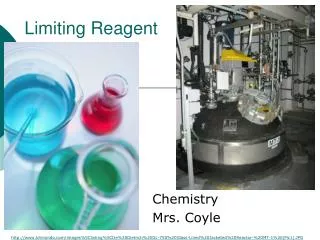
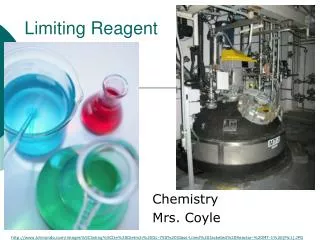
Limiting Reagent Chemistry Mrs. Coyle http://www.kitmondo.com/images%5Clisting%5CDe%20Dietrich%20GL-750%20Glass-Lined%20Jacketed%20Reactor-%20MT-1%20(Pic1).JPG
What happens in a chemical reaction, if there is an insufficient amount of one reactant? http://ossfabricators.com/photos/reactor2.jpg
Limiting Reagent: the reagent that is completely used up in a chemical reaction. • Excess Reagent: reagent not completely used up in a chemical reaction.
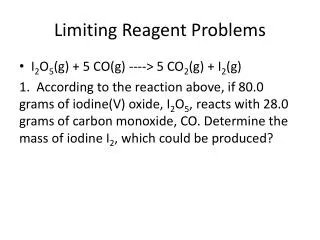
Example:Find the limiting reagent when 1.22g O2 reacts with 1.05g H2 to produce H2O. • There are two solution methods you could use. • In both methods, the first step is to convert the mass to moles.
Method 1 • Use the moles of one reactant to calculate the necessary moles of the other reactant to fully react. • Compare the calculated value with the actual value to see if this reagent is excess or limiting.
Example: Find the limiting reagent when 1.22g O2 reacts with 1.05g H2 to produce H2O. Answers using method 1: • Convert mass to moles: 0.038 mol O2, 0.5 mol H2 • Calculate H2 moles necessary to react with O2:0.076 mol H2. • Compare 0.076 mol H2to actual mol of H2 (0.5mol H2), • Since 0.5 mol H2 is more than 0.076 mol H2, H2 is the excess reagent and O2 is the limiting reagent.
Method 2 • Use the moles of each of the reactant to calculate one of the products. • The reagent that gave the smaller calculated value of product is the limiting reagent. • The actual value of the amount of product is the smaller of the calculated values.
Example: Find the limiting reagent when 1.22g O2 reacts with 1.05g H2 to produce H2O. Answers using Method 2: • Convert mass to moles: 0.038 mol O2, 0.5 mol H2 • Calculate H2Omoles produced by using each of the reactants: • Using O2: 0.076 mol H2O. • Using H2: 0.5 mol H2O. • The actual amount H2O produced is the smaller one of the two values(0.076mol H2O). • O2 is the limiting reagent, since O2 was used in the calculation of the 0.076mol H2O.