
SlideServe
Menu
Préférences
© SlideServe · v2026

Limiting Reagent Notes

shermanc avatar
5 diapositives · 93 Views · Jan 07, 2020

Understand the concept of limiting reagent in chemistry, solve practice problems to determine the reactant ratio, and calculate product yields accurately.
Limiting Reagent Notes - slide 1
01 / 5Limiting Reagent Notes
1 / 17

Télécharger la présentation

Limiting Reagent Notes
Une image / un lien ci-dessous est fourni (tel quel) pour télécharger la présentation

Politique de téléchargement : le contenu du site vous est fourni TEL QUEL pour votre information et votre usage personnel ; il ne peut être vendu, concédé sous licence ni partagé sur d’autres sites sans l’accord de son auteur.Le contenu vous est fourni TEL QUEL, pour votre information et votre usage personnel uniquement. Téléchargez la présentation en cliquant sur ce lien. Lors du téléchargement, si vous ne parvenez pas à télécharger une présentation, l’éditeur a peut-être supprimé le fichier de son serveur.Pendant le téléchargement, si vous ne parvenez pas à obtenir une présentation, le fichier a peut-être été supprimé par l’éditeur.

F I N

Plus de contenu associé

Transcription de la présentation
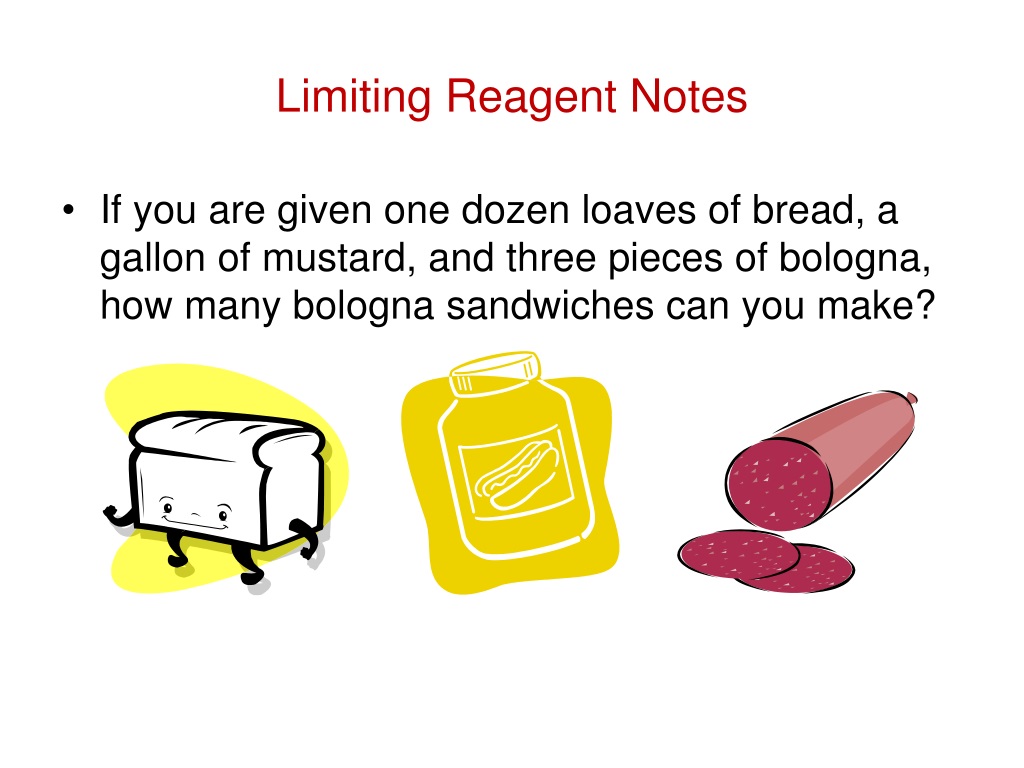
  1. Limiting Reagent Notes • If you are given one dozen loaves of bread, a gallon of mustard, and three pieces of bologna, how many bologna sandwiches can you make?

  2. Limiting Reagent (or Limiting Reactant) • The limiting reagent is the reactant that ___________ _____ first. • The reactant that is in abundance is called the ___________ reagent. • The limiting reagent determines how much product you can make. runs out excess The number of car bodies is the limiting reagent since you will run out of bodies before tires. The tires will be the excess reagent.

  3. Calculations Step 1: To solve a limiting reactant problem you must do twostoichiometry problems. The one that makes the least product is the limiting reagent. Step 2:Practice Problems: 2Na + Cl2 2NaCl 1) 6.70 grams of sodium reacts with 3.20 grams of chlorine. How many grams of sodium chloride will be formed? x1 x2 y 58 g NaCl 1 mol Na 2 mol NaCl 6.7 g Na 16.90 g NaCl x = x x 1 mol NaCl 23 g Na 2 mol Na 1 mol Cl2 2 mol NaCl 58 g NaCl 3.20 g Cl2 x 5.3 g NaCl x x = 70 g Cl2 1 mol Cl2 1 mol NaCl 3.20g of Cl2 is the limiting reagent because it made the least product.

  4. Calculations Step 1: To solve a limiting reactant problem you must do twostoichiometry problems. The one that makes the least product is the limiting reagent Step 2:Practice Problems: 2Cu + S  Cu2S 1) Copper reacts with sulfur to form copper (I) sulfide. If 18.0 grams of copper reacts with 25.0 grams of sulfur how much Cu2S will be formed? x1 x2 y 160 g Cu2S 1 mol Cu 1 mol Cu2S 18.0 g Cu 22.5 g Cu2S x = x x 1 mol Cu2S 64 g Cu 2 mol Cu 1 mol S 1 mol Cu2S 160 g Cu2S 25 g S x 125 g Cu2S x x = 32 g S 1 mol S 1 mol Cu2S 18.0 g Cu is the limiting reagent because it made the least product.

  5. Calculations Step 1: To solve a limiting reactant problem you must do twostoichiometry problems. The one that makes the least product is the limiting reagent. Step 2:Practice Problems: 2 Na + 2 H2O  2 NaOH + H2 1) If 90.0 grams of sodium is dropped in 80.0 g of water. How many grams of hydrogen (H2) would be produced? What reactant is in excess? y x1 x2 2 g H2 1 mol Na 1 mol H2 90 g Na 3.91 g H2 x = x x 1 mol H2 23 g Na 2 mol Na 1 mol H2O 1 mol H2 2 g H2 80 g H2O x x x 4.44 g H2 = 18 g H2O 2 mol H2O 1 mol H2 90 g of Na is the limiting reagent because it made the least product.