Prenatal Alcohol Consumption
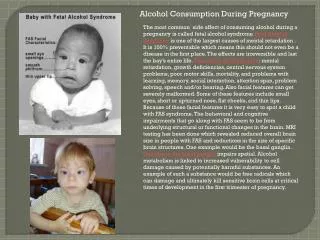
Prenatal alcohol consumption can have severe implications for fetal brain development, leading to disorders such as Fetal Alcohol Syndrome (FAS). Research indicates that alcohol traverses the placenta more rapidly than in the human body, affecting growth patterns and brain size. Experiments demonstrated that alcohol exposure in mice resulted in significantly lower brain weights and abnormal growth rates, similar effects observed in chick brains. The research highlights the critical nature of maternal alcohol use and its link to mental illness, spontaneous abortions, and long-term developmental issues in offspring.

Prenatal Alcohol Consumption
E N D
Presentation Transcript
Prenatal Alcohol Consumption And It’s Relation To The Brain Fateh Mann
Fetal Alcohol Syndrome • Disorganization that results from alcohol consumption • Mental illness is always present in some form • Alcohol maneuvers through the placenta quicker than the human body
Growth Patterns • Experiment tested the brain size of mice • Nathaniel, Nathaniel, and Mohamed • Found that the weight of the brain was much lower • Body and brain grew at abnormal rates
Similar effects on chick brains • Pennington sprayed 1 gram of ehtanol at the beginning of incubation • Findings were similar to previous findings on Sprague-Dawley rats • Blood alcohol concentration • Indomethacin lowers blood alcohol level
Macaque Primates • Researchers knew the brain would decrease in size • Farber, Creeler, and Onley • Looked for apoptosis by staining the brain for damage • Found controlled neuroapoptosis in specified areas
Related damage • Alcohol effects the mother as well as the child • Spontaneous abortions and premature births • Mental instability remains in the child
Conclusion • Alternating Indomethacin to work affectively on mammals • Stem cell research using neurological stem cells