Download
1 / 6
60 likes | 212 Vues
This analysis explores the dark era of Stalin's rule in the Soviet Union, characterized by fear and forced labour aimed at rapid modernisation and industrialisation. Highlighting the establishment of Gulags, where millions endured horrific conditions, it examines the oppressive tactics employed by Stalin to eliminate dissent, including purges and mass arrests orchestrated by the NKVD. The legacy of these brutal policies shaped Soviet society, instilling a culture of fear that compelled peasants to comply with collectivisation efforts, ultimately serving Stalin's ambitions for control.

E N D
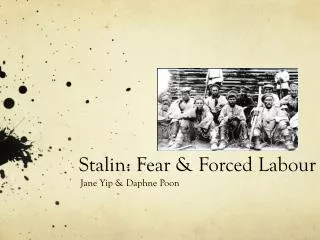
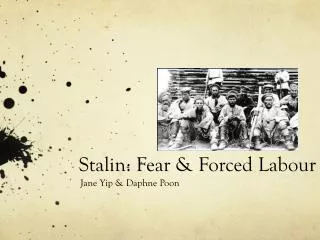
Stalin: Fear & Forced Labour Jane Yip & Daphne Poon
Introduction • Urgent need for modernisation • Wanted to catch up with the Western powers • Wanted to show how Communism could work • Became paranoid: wanted to create a unified Russia under his control
Gulags • “Work or face consequences” • Gulag: government agency that administered Soviet labour camp systems, started on April 25 1930 • Remote parts of Russia: harsh climatic conditions • Initially only for prisoners, later for anyone who opposed Stalin and peasants who refused to work • High mortality at the camps and extremely poor living conditions • March 1940: 53 camps, 423 labour colonies – today’s major Russian industrial cities were originally camps
First Purges, 1930-33 • Purged anyone who opposed industrialisation and collectivisation • Workers were afraid of being purged/of having family members purged: protests were swallowed and people worked.
Secret Police • NKVD: People’s Commissariat for Internal Affairs • Main duties: running of the labour camp system, suppressing underground resistance, mass deportations and executions, espionage, guarding state borders and general reinforcement of policies • 1934 Communist Party Congress: 1108 arrested out of 1966 in next five years • 1935-41: 19.8 million people arrested by NKVD (7 million executed) • Interrogated prisoners to the point of mental exhaustion – threats to execute family • Interrogations lasted several days until confessions were signed • Many did not know the reason for their arrests – arrests happened anytime • Stalin even purged members of the secret police – first three heads were executed at his command
Conclusion • Fear and forced labour was arguably Stalin’s most successful method • Fear of death worked immensely well in motivating peasants to accept collectivisation and work hard • Present of Secret Police helped to keep fear afresh