Download
1 / 12
180 likes | 370 Vues
Explore the four essential types of business letters based on Dr. Jennifer L. Bowie's framework. This guide compares direct and indirect approaches for effective communication, highlighting best practices for inquiries, special requests, sales, and customer relations letters. Learn how to structure your letter from introduction to conclusion, focusing on reader orientation and respectful tone. Gain insights into handling good and bad news, express complaints effectively, and maintain customer trust. Whether you're asking for information or making a sales pitch, this guide will enhance your business writing skills.

E N D
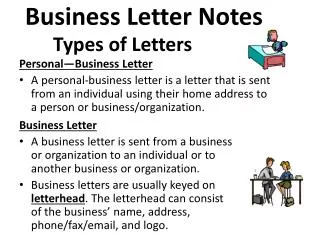
Four Types of Business Letters Based off of Kolin Chapter 6 For Business Writing By Dr. Jennifer L. Bowie
Two Letter Techniques: Direct vs. Indirect • Best for: • Good news • Non-emotional issues • Audiences that prefer a straightforward approach • Best for: • Bad news • Less direct readers (some international) • Sensitive situations • Issues that need explaining • Introduction: • Establishes a reason for writing • Presents main idea • Introduction: • Acts as a buffer with a positive or neutral statement • Compliments the readers, agrees, appreciates, thanks, and more • Body: • Provides and explains details • Body: • Explains situation first • Leads up to the point/issue • States point/issue • If possible, links bad news with benefits • Does not place blame • Conclusion: • Reminds of any deadlines • Presents call for action • Looks to future • Conclusion: • Does not apologize • Gracious closing
Tips For Business Letters • Think of them as mainly persuasive documents • Write a reader-orientated document not a writer-oriented document • Be respectful
Inquiry Letters Purpose: Ask for information • State clearly what information you are requesting and why • Write specific, concise, to the point questions that are both easy to understand and easy to answer • Use bullets to highlight the questions • Leave space for the readers to answer the questions • Attach a questionnaire if you have more than 5 questions • Specify when you need the answers by • Thank the reader
Special Request Letters Purpose: Make a special demand • State clearly who you are and why you are writing • Convince the reader to help • Show you are hard working • Discuss your reason for the request • Show you understand the situation and have done research • Discuss why the person you are writing to is the best person to help • Write specific, concise, to the point questions that are both easy to understand and easy to answer • Use bullets to highlight the questions • Leave space for the readers to answer the questions • Attach a questionnaire if you have more than 5 questions • Specify when you need the answers by • Thank the reader • Offer the reader a copy of the report or results • Ask for necessary permissions
Sales Letters Purpose: to persuade the readers to “buy” a product, service, idea, or point of view • Grab the reader’s attention • Highlight the product’s appeal • Show the product's use • Conclude with a request for action (buy it!) • Appeal to the reader with reader-centered issues (health, convenience, service, saving money…) • Use concrete words and colorful verbs • Be ethical and truthful • Don’t brag or go on
Customer Relations Letters Purpose: establish and maintain good relationships with the customers • Be diplomatic • Be persuasive • Write from and understand the reader’s perspective • There are several types…
Claim Letters: A Type of Customer Relations Letter Purpose: Express a complaint and request specific action (must have both) • Choose a direct or indirect approach • Direct is best for routine claim letters: claim is backed by guarantee, warrantee, contract, reputation, or more • Indirect is best for arguable claim letters: when the claim is debatable or unusual • Use a professional, rational, if possible positive, tone, and not a hostile, negative, and/or emotional tone • Clearly describe product or service with necessary details • Explain the problem with details • Propose a fair, precise, and appropriate request/adjustment • Present an explicit deadline
Adjustment Letters: AType of Customer Relations Letter Purpose: Respond to claim letter with solution • Work to reconcile the situation and restore the customer's trust in your company • “Be prompt, courteous, and decisive” • Use a positive or neutral tone without being begrudging or taking full blame • Two types: “Yes” or “No”
“Yes” Adjustment Letters • Start with an apology and admit claim is justified • Quickly present favorable news • Specifically state how you are correcting the problem • Explain what happened and why • Conclude with a friendly, positive note
“No” Adjustment Letters • Use an indirect approach • “Thank the customer for writing” • Restate the customer’s problem • Explain what happened and why without placing blame • Clearly state discussion without hedging • Link “no” to benefits • Conclude with concise gracious statement to (leave) open the door to future business