Download
1 / 18
180 likes | 295 Vues
This lecture delves into the application of stress tensors in analyzing blood flow forces acting on endothelial cells (ECs). We explore the Voigt solution for 3-dimensional stresses and examine the equilibrium of stress components. Key topics include the upper membrane analysis, membrane tension definitions, and fluid dynamics surrounding the ECs. Additionally, we discuss the implications of stress from fluid pressure, which is omnidirectional, on cellular behavior. The session also covers probability integral coding in relation to pulse frequency modulation, essential for understanding control systems in climate and temperature regulation.

E N D
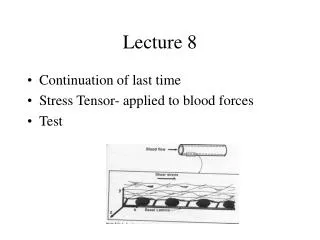
Lecture 8 • Continuation of last time • Stress Tensor- applied to blood forces • Test
Y X Z 3-Dimensional stresses (stress tensor)
y x z Blood Forces on ECs Y.C. Fung
y x z Analysis of EC upper membrane Symmetrical (Fluid Mosaic)
y x z On surface facing blood On surface facing cytosol
y x z Static Eq
y x z On surface facing blood Define We need membrane tension as f(t)
y x z (if Tx= 0 @ x=0)
For t = 1 N/m2 , L= 10 mm, h = 10 nm Stress on cell from flow @ x = -L 0 L For L= 1 cm, sxx= 106
Fluid Pressure is omnidirectional Hence P1=P2=P3=P4=P5 =P
Coding of Probability Integral pulse frequency modulation Probability Pulse frequency and width Modulation
Pulse Width Modulator Inputs Leaky integrator Thresholder Pulses out Reset
1/s X2 + 1/s X1 - 1 3