Muscles Continued
This section explores the essential functions of skeletal muscles, detailing how their action is determined by the type of joint and their attachment points. Key concepts include the muscle's origin (immovable end) and insertion (movable end), as well as the roles of prime movers, synergists, and antagonists during movement. Examples of major skeletal muscles and their characteristics are provided, along with an overview of muscles responsible for facial expressions, mastication, and head movements. Resources for further study are referenced.

Muscles Continued
E N D
Presentation Transcript
Muscles Continued Pages: 192-197
Skeletal Muscle Action • Dependent mostly on the kind of joint it is associated with and the way the muscles attaches on either side of that joint. • Origin: • Immovable end of a muscle • Insertion: • Movable end of a muscle • During contraction, insertion is pulled towards origin • Some muscles have more than one origin or insertion • Ex. Biceps brachii
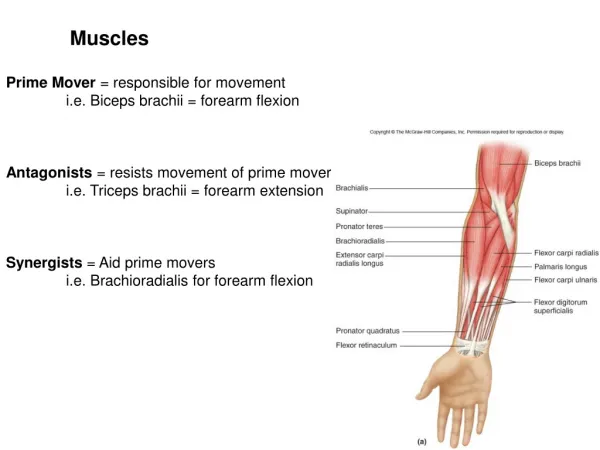
Interaction of Skeletal Muscles • Almost always function in groups • Prime Mover: • Provides most movement • Synergists: • Muscles that contract and assist the prime mover • Antagonists: • Resist a prime mover’s action and causes movement in the opposite direction.
Major Skeletal Muscles • Name of muscle is often describes the muscles: • Relative size • Shape • Location • Action • Number of attachments • Direction of its fibers • Examples: Pectoralis Major-of large size located in the pectoral region, Deltoid: shaped like a delta or triangle, Extensor digitorum: extends the digits
Muscles of Facial Expression • Responsible for expressions of surprise, sadness, anger, fear, disgust, and pain • Include: • Epicranius • Composed of two parts: Frontalisand Occipitalis • Orbicularis oculi • Orbicularis oris • Buccinator • Zygomaticus • Platysma
Muscles of Mastication • Attached to mandible and produce chewing movements • Include: • Masseter • Temporalis
Muscles That Move the Head • Flex, extend and rotate • Include: • Sternocleidomastoid • Splenius capitis • Semispinaliscapitis
Action Origin Insertion • Please use table 8.4, 8.5 and 8.6 to fill out your AOI word document. • Frontalis • Occipitalis • Orbicularis oculi • Orbicularis oris • Buccinator • Zygomaticus • Platysma • Masseter • Temporalis • Sternocleidomastoid • Splenius capitis • Semispinaliscapitis