Long-Term Evolutionary Studies: Understanding Adaptation through Natural Selection
This chapter explores long-term evolutionary experiments that provide insights into adaptation and evolutionary mechanisms. By examining classical studies such as the Galapagos finches and African cichlids, it highlights the differences between short-term and long-term selection studies. Long-term investigations allow scientists to evaluate genetic and environmental factors affecting adaptation and causality of evolutionary changes. These insights underscore the complexity of natural selection, emphasizing the role of chance and diversity in evolutionary processes.

Long-Term Evolutionary Studies: Understanding Adaptation through Natural Selection
E N D
Presentation Transcript
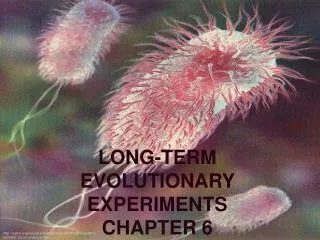
LONG-TERM EVOLUTIONARY EXPERIMENTSCHAPTER 6 http://natsci.edgewood.edu/wingra/Student%20Projects%202008/E.%20Coli/default.htm
ADAPTIVE RADIATION STUDIES PROVIDE LIMITED INFORMATION AS TO WHY IT HAPPENED AND WHAT OTHER POSSIBILITIES MAY HAVE BEEN POSSIBLE. http://news.nationalgeographic.com/news/bigphotos/83795719.html CLASSICAL STUDIES: GALAPAGOS FINCHES, AFRICAN CICHLIDS, STICKLEBACKS
SHORT-TERM SELECTION VERSUS LONG-TERM STUDIES SHORT-TERM limited number of generations Can lead to erroneous inferences regarding genetic correlations LONG-TERM Association of organism and environment is open-ended Direct investigation of why an adaptation happened (causality) Model organisms - insects (Drosophila) or microbes (E. coli) Long-term studies are able to study the importance of chance impacts on adaptation THE THEORY OF EVOLUTION BY NATURAL SELECTION PROVIDES A CAUSE-AND-EFFECT FRAMEWORK (EVEN MATHEMATICALLY) BUT NOT THE MECHANISMS. www.nature.com http-//louisproyect.wordpress.com
CLONAL INTERFERENCE MAINTAINS DIVERSITY Periodic selection : natural selection recurrently purges diversity within a bacterial population Recombination in bacteria is rare Diversity is generally transient Larger populations (possible via long-term studies) >> multiple beneficial mutations>> diversity persists 3 ways ( Dr. Bennett) http-//www.nature.com/nrg/journal/v4/n6/box/nrg1088_BX2
ADAPTIVE RADIATION:Trade-off between resource breadth and competitive ability • Organism may be good at using one resource and not another>>>leads to co-existence of species http://natsci.edgewood.edu/wingra/Student%20Projects%202008/E.%20Coli/default.htm
SUMMARY Long-term studies • direct observation of adaptation • mechanisms of adaptation • evaluation of environmental and genetic factors • causality of evolutionary change
References • http://abcnews.go.com/Technology/DyeHard/climate-change-find-tiny-stickleback-fish-evolved-temperatures/story?id=11368797 • http://www.plosbiology.org/ • http://www.biomedcentral.com/1471-2148/10/11 • http://beaker.biology.washington.edu/research/pubs/2002/Bohannan_et_al2002.pdf • http://www.hhmi.org/genesweshare/e120.html • http://www.nature.com • http://www.nanobugs.com/ • http://www.ncbi.nlm.nih.gov • http://news.nationalgeographic.com/news/bigphotos/83795719.html http://www.plosbiology.org/article/info:doi%2F10.1371%2Fjournal.pbio.1000250