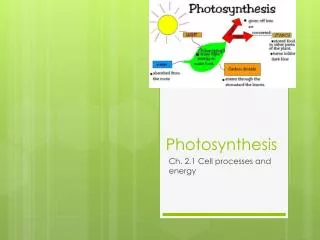
Photosynthesis
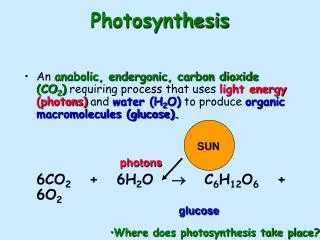
Photosynthesis. Light Reaction vs. Dark Reaction (Calvin Cycle). What is ATP?. Adenosine triphosphate One of the principal energy compounds that living things use to store energy. It acts like a fully charged battery for the cell.

Photosynthesis
E N D
Presentation Transcript
Photosynthesis Light Reaction vs. Dark Reaction (Calvin Cycle)
What is ATP? • Adenosine triphosphate • One of the principal energy compounds that living things use to store energy. • It acts like a fully charged battery for the cell. • Energy is released from ATP when it is converted to ADP by removing a phosphate.
What is ATP? • Great at transferring energy, but not good for long term storage • Cells just regenerate ATP from ADP as needed by using the energy in carbohydrates like glucose
Light-Dependent Reactions • KEY: • The light-dependent reactions use energy from sunlight to produce ATP, NADPH, and oxygen. • (NADPH is another carrier molecule like ATP…it carries 2 high-energy electrons) • Takes place in the thylakoid
Inside a Chloroplast H2O Light NADP+ ADP + P Light- dependent reactions Calvin Cycle Chloroplast O2
Light-Dependent Reactions • Energy from light is absorbed by electrons, making them “high-energy electrons” • These electrons are passed along an “electron transport chain” • The electrons come from the splitting of water molecules
Light-Dependent Reactions • Photosynthesis begins when pigments in photosystem II absorb light, increasing their energy level. Photosystem II
Light-Dependent Reactions • These high-energy electrons are passed on to the electron transport chain. Photosystem II Electroncarriers High-energy electron
Light-Dependent Reactions • Enzymes on the thylakoid membrane break water molecules into: Photosystem II 2H2O Electroncarriers High-energy electron
Light-Dependent Reactions • hydrogen ions • oxygen atoms • energized electrons Photosystem II + O2 2H2O Electroncarriers High-energy electron
Light-Dependent Reactions • The energized electrons from water replace the high-energy electrons that chlorophyll lost to the electron transport chain. Photosystem II + O2 2H2O High-energy electron
Light-Dependent Reactions • As plants remove electrons from water, oxygen is left behind and is released into the air. Photosystem II + O2 2H2O High-energy electron
Light-Dependent Reactions • The hydrogen ions left behind when water is broken apart are released inside the thylakoid membrane. Photosystem II + O2 2H2O High-energy electron
Light-Dependent Reactions • Energy from the electrons is used to transport H+ ions from the stroma into the inner thylakoid space. Photosystem II + O2 2H2O
Light-Dependent Reactions • High-energy electrons move through the electron transport chain from photosystem II to photosystem I. Photosystem II + O2 2H2O Photosystem I
Light-Dependent Reactions • Pigments in photosystem I use energy from light to re-energize the electrons. + O2 2H2O Photosystem I
Light-Dependent Reactions • NADP+ then picks up these high-energy electrons, along with H+ ions, and becomes NADPH. + O2 2H2O 2 NADP+ 2 NADPH 2
Light-Dependent Reactions • As electrons are passed from chlorophyll to NADP+, more H+ ions are pumped across the membrane. + O2 2H2O 2 NADP+ 2 NADPH 2
Light-Dependent Reactions • Soon, the inside of the membrane fills up with positively charged hydrogen ions, which makes the outside of the membrane negatively charged. + O2 2H2O 2 NADP+ 2 NADPH 2
Light-Dependent Reactions • The difference in charges across the membrane provides the energy to make ATP + O2 2H2O 2 NADP+ 2 NADPH 2
Light-Dependent Reactions • H+ ions cannot cross the membrane directly. ATP synthase + O2 2H2O 2 NADP+ 2 NADPH 2
Light-Dependent Reactions • The cell membrane contains a protein called ATP synthase that allows H+ ions to pass through it ATP synthase + O2 2H2O 2 NADP+ 2 NADPH 2
Light-Dependent Reactions • As H+ ions pass through ATP synthase, the protein rotates. ATP synthase + O2 2H2O 2 NADP+ 2 NADPH 2
Light-Dependent Reactions • As it rotates, ATP synthase binds ADP and a phosphate group together to produce ATP. ATP synthase + O2 2H2O ADP 2 NADP+ 2 NADPH 2
Light-Dependent Reactions • Because of this system, light-dependent electron transport produces not only high-energy electrons but ATP as well. ATP synthase + O2 2H2O ADP 2 NADP+ 2 NADPH 2
Calvin Cycle • KEY: • Uses ATP and NADPH to produce high-energy sugars. • It does not require light. • Takes place in the stroma.
Inside a Chloroplast H2O CO2 Light NADP+ ADP + P Light- dependent reactions Calvin cycle Calvin Cycle Chloroplast Sugars O2
Calvin Cycle • Uses 6 molecules of carbon dioxide to produce a singe 6-carbon sugar molecule. • The plant uses the sugar for energy and to build more complex carbohydrates (starch and cellulose).
The Calvin Cycle • Six carbon dioxide molecules enter the cycle from the atmosphere and combine with six 5-carbon molecules. CO2 Enters the Cycle
The result is twelve 3-carbon molecules, which are then converted into higher-energy forms. The Calvin Cycle
The Calvin Cycle • The energy for this conversion comes from ATP and high-energy electrons from NADPH. Energy Input 12 12 ADP 12 NADPH 12 NADP+
The Calvin Cycle • Two of twelve 3-carbon molecules are removed from the cycle. Energy Input 12 12 ADP 12 NADPH 12 NADP+
The Calvin Cycle • The molecules are used to produce sugars, lipids, amino acids and other compounds. 12 12 ADP 12 NADPH 12 NADP+ 6-Carbon sugar produced Sugars and other compounds
The Calvin Cycle • The 10 remaining 3-carbon molecules are converted back into six 5-carbon molecules, which are used to begin the next cycle. 12 12 ADP 6 ADP 12 NADPH 6 12 NADP+ 5-Carbon MoleculesRegenerated Sugars and other compounds
WRAP-UP… • The two sets of photosynthetic reactions work together. • The light-dependent reactions trap sunlight energy in chemical form. • The light-independent reactions use that chemical energy to produce stable, high-energy sugars from carbon dioxide and water.
REVIEW ? • In plants, photosynthesis takes place inside the • thylakoids. • chloroplasts. • photosystems. • chlorophyll.
REVIEW ? • Energy to make ATP in the chloroplast comes most directly from • hydrogen ions flowing through an enzyme in the thylakoid membrane. • transfer of a phosphate from ADP. • electrons moving through the electron transport chain. • electrons transferred directly from NADPH.
REVIEW ? • NADPH is produced in light-dependent reactions and carries energy in the form of • ATP. • high-energy electrons. • low-energy electrons. • ADP.
REVIEW ? • What is another name for the Calvin cycle? • light-dependent reactions • light-independent reactions • electron transport chain • photosynthesis