Understanding Protective Actions: Evacuation vs. Sheltering in Place
This guide explores two key protective actions—evacuation and sheltering in place—during emergencies. Evacuation is essential for moving people to safety but can be logistically challenging. Sheltering in place may be the only viable option in certain situations. Decision-makers must consider various factors, including the nature of the threat, population needs, and available resources. Clear communication is vital to ensure that directives are understood, as mixed messages can lead to confusion. This guide highlights the crucial roles of authorities and the considerations involved in selecting protective actions.

Understanding Protective Actions: Evacuation vs. Sheltering in Place
E N D
Presentation Transcript
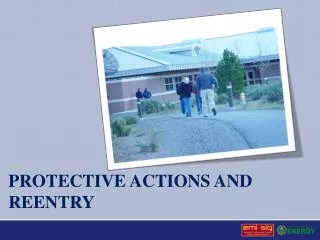
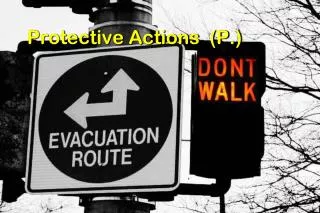
Protective Actions • Two key actions “Protective Actions” • “Evacuation” • “Sheltering in Place or In-Place Protection” I-2
Evacuation • Purpose of “Evacuation” • Remove people from threatened area to a safe area. I-2
Evacuation • Evacuation: preferred protective action • But, logistically/operationally difficult I-2
Shelter in Place/In-Place Protection • Purpose — • Keep people inside protective structure. • May be only practical protective action. I-2
Selecting Protective Actions • Important but difficult decision • May be no right answer I-2
Authorities for Protective Actions • Basic police power • Restrict movement • Done during an emergency • Usually officially enacted I-4
Authorities for Protective Actions • Specific authority • PC §409.5 • Close or restrict area • “Disaster” scene I-4
Authorities for Protective Actions • Emergency Services Act • GC §8634 • Local gov’t may issue orders • Protect life and property I-4
Specific Areas & Locations • Highways • CalTrans • Highway Patrol DeRose Drayage I-4
Specific Areas & Locations • Waterways • Dept. of Boating & Waterways • Dept. of Water Resources • U. S. Coast Guard I-4
Protective Action Considerations • Requires 6 basic considerations. I-6
Decision Considerations • Materials involved • Physical state • Physical properties • Toxicity I-6
Decision Considerations • Population threatened I-6
Decision Considerations • Responder resources & capabilities I-6
Decision Considerations • Time factors involved I-6
Decision Considerations • Current and predicted weather I-6
Decision Considerations • Ability to communicate with public I-6
Protective Action Messages • Must be clear and concise • Are to be evacuated • Evacuation routes I-8
Protective Action Messages • Speak with one voice • Mixed messages? • Confusion = no action Leave? Stay? Leave? Stay? Leave? Stay? I-8
Traffic Control • People leave the way they entered • People follow familiar routes • Plan accordingly! I-8
Special Populations • Ability of population to help themselves? • Need some assistance to move? • Incapable of being moved? I-8
Special Populations • May require Shelter-in-Place I-8
ERG & Protective Actions • Orange-bordered pages • Isolation distances • Evacuation distances I-10
ERG & Protective Actions • Green-bordered pages • Table 1 • Table 2 • Table 3 I-10
ERG & Protective Actions • Day vs. Night? I-10
Day • Atmosphere more “active” • Material disperses more quickly I-10
Night • Atmosphere more “stable” • Material disperses less quickly I-10
Summary • Selecting an option is half the job • No choice will be easy to implement I-10