01 / 52AAT-A Date: 12/10/13 SWBAT add and multiply radicals
1 / 17
Télécharger la présentation
AAT-A Date: 12/10/13 SWBAT add and multiply radicals
Une image / un lien ci-dessous est fourni (tel quel) pour télécharger la présentation
Politique de téléchargement : le contenu du site vous est fourni TEL QUEL pour votre information et votre usage personnel ; il ne peut être vendu, concédé sous licence ni partagé sur d’autres sites sans l’accord de son auteur.Le contenu vous est fourni TEL QUEL, pour votre information et votre usage personnel uniquement.Téléchargez la présentation en cliquant sur ce lien.Lors du téléchargement, si vous ne parvenez pas à télécharger une présentation, l’éditeur a peut-être supprimé le fichier de son serveur.Pendant le téléchargement, si vous ne parvenez pas à obtenir une présentation, le fichier a peut-être été supprimé par l’éditeur.
F I N
Plus de contenu associé
Transcription de la présentation
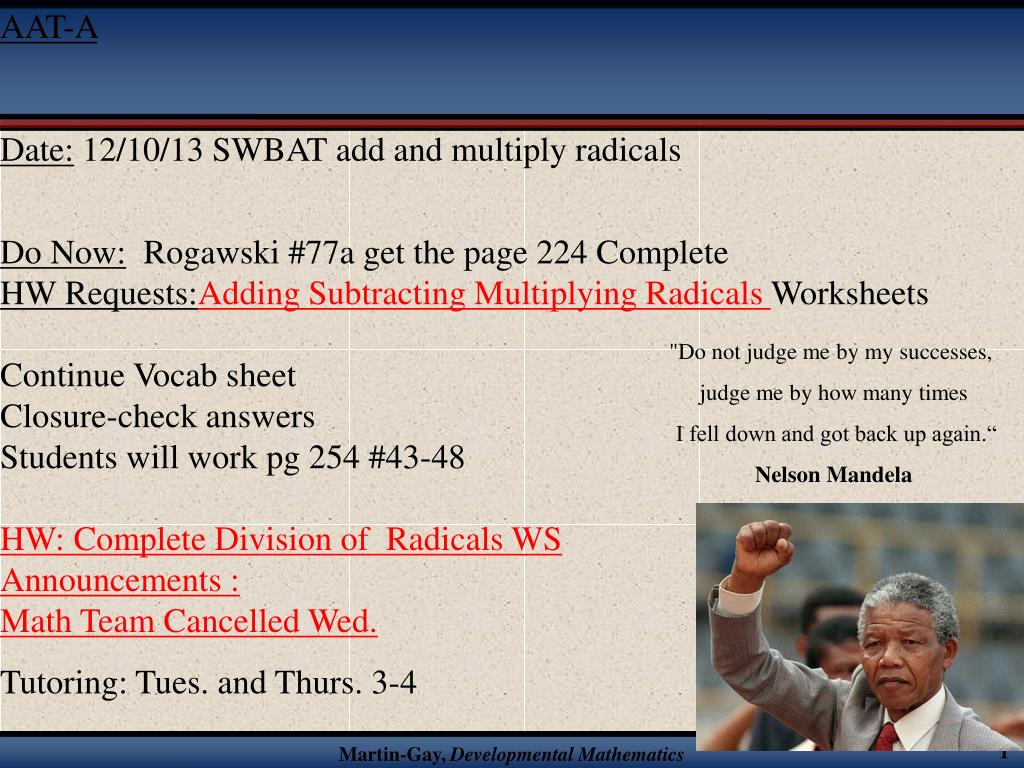
AAT-A Date: 12/10/13 SWBAT add and multiply radicals Do Now:Rogawski #77a get the page 224 Complete HW Requests:Adding Subtracting Multiplying Radicals Worksheets Continue Vocab sheet Closure-check answers Students will work pg 254 #43-48 HW: Complete Division of Radicals WS Announcements : Math Team Cancelled Wed. Tutoring: Tues. and Thurs. 3-4 "Do not judge me by my successes, judge me by how many times I fell down and got back up again.“ Nelson Mandela
Rationalizing the Denominator Rationalizing the denominator -rewrite a radical quotient with the radical confined to ONLY the numerator. There is no radical in the denominator! Process: Multiply the quotient by a form of 1 to eliminate the radical in the denominator.
Conjugates To simplify rational quotients with a sum or difference of terms in a denominator, rather than a single radical. Process: Multiply by the conjugate of the numerator or denominator (which ever one we are rationalizing). The conjugate uses the same terms, but the opposite operation (+ or ).
Sums and Differences Rules in the previous section allowed us to split radicals that had a radicand which was a product or a quotient. We can NOT split sums or differences.
Like Radicals “like” terms- terms with the same variables raised to the same powers can be combined through addition and subtraction. Like radicals are radicals with the same index and the same radicand. Like radicals can be combined with addition or subtraction by using the distributive property.
Square Roots Opposite of squaring a number is taking the square root of a number. A number b is a square root of a number a if b2 = a. In order to find a square root of a, you need a # that, when squared, equals a.
Principal Square Roots The principal (positive) squareroot is noted as The negative square root is noted as
Radicands Radical expression is an expression containing a radical sign. Radicand is the expression under a radical sign. Note that if the radicand of a square root is a negative number, the radical is NOT a real number.
Finding the nth root of a number • Finding the square root of a number involves finding a number that, when squared, equals the given number. • In other words, finding such that b2 = a. • Some vocabulary involved with nth roots: n is the indexof the expression. The index tells us what amount of factors we should look for in order to simplify a quantity. Examples: If n = 3, we are looking for some value r such that r3 = s. If n = 4, we are looking for some value r such that r4 = s. This is called a radical symbol. s is called the radicand of the radical expression. If the index n is even, then s must be positive. This is because there is no value of r such that r2 = -s.
nth Roots If the index, n, is even, the root is NOT a real number when a is negative. If the index is odd, the root will be a real number. The nth root of a is defined as *
Perfect Squares Square roots of perfect square radicands simplify to rational numbers (numbers that can be written as a quotient of integers). Square roots of numbers that are not perfect squares (like 7, 10, etc.) are irrationalnumbers. IF REQUESTED, you can find a decimal approximation for these irrational numbers. Otherwise, leave them in radical form.
Perfect Square Roots Radicands might also contain variables and powers of variables. To avoid negative radicands, assume for this chapter that if a variable appears in the radicand, it represents positive numbers only. Example
Using the absolute value with radicals Let b = 1, then Now, let b = -1 but To make sure that the answer is positive we add an absolute value. If b is positive there is no problem, however, if b is negative we need |b|
Simplifying Radicals Simplify the following radical expressions. Factor radicand, isolate perfect squares, then simplify Example No perfect square factor, so the radical is already simplified.
Extraneous Solutions Power Rule (text only talks about squaring, but applies to other powers, as well). If both sides of an equation are raised to the same power, solutions of the new equation contain all the solutions of the original equation, but might also contain additional solutions. A proposed solution of the new equation that is NOT a solution of the original equation is an extraneous solution.
Solving Radical Equations Example Solve the following radical equation. Substitute into the original equation. true So the solution is x = 24.
Solving Radical Equations Example Solve the following radical equation. Substitute into the original equation. Does NOT check, since the left side of the equation is asking for the principal square root. So the solution is .
Solving Radical Equations Steps for Solving Radical Equations • Isolate one radical on one side of equal sign. • Raise each side of the equation to a power equal to the index of the isolated radical, and simplify. (With square roots, the index is 2, so square both sides.) • If equation still contains a radical, repeat steps 1 and 2. If not, solve equation. • Check proposed solutions in the original equation.
Solving Radical Equations Example Solve the following radical equation. Substitute into the original equation. true So the solution is x = 2.
Solving Radical Equations Example continued Substitute the value for x into the original equation, to check the solution. true So the solution is x = 3. false
Solving Radical Equations Example continued Substitute the value for x into the original equation, to check the solution. true true So the solution is x = 4 or 20.
The Pythagorean Theorem Pythagorean Theorem In a right triangle, the sum of the squares of the lengths of the two legs is equal to the square of the length of the hypotenuse. (leg a)2 + (leg b)2 = (hypotenuse)2
c = inches Using the Pythagorean Theorem Example Find the length of the hypotenuse of a right triangle when the length of the two legs are 2 inches and 7 inches. c2 = 22 + 72 = 4 + 49 = 53
The Distance Formula By using the Pythagorean Theorem, we can derive a formula for finding the distance between two points with coordinates (x1,y1) and (x2,y2).
Connexion au compte
Connectez-vous pour publier votre contenu sur SlideServe.