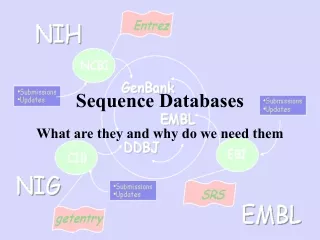
Searching Sequence Databases
This course provides an overview of bioinformatics database searching, focusing on local sequence alignment techniques using the BLAST (Basic Local Alignment Search Tool) algorithm. We explore how to find short sequences within larger databases and the significance of database hits. The BLAST method improves search speed while balancing sensitivity and accuracy. Participants will learn about word indexing, high scoring pairs (HSP), and methods for evaluating alignment scores to determine the significance of matches.

Searching Sequence Databases
E N D
Presentation Transcript
BIO/CS 271 – Introduction to Bioinformatics Searching Sequence Databases
Database Searching • How can we find a particular short sequence in a database of sequences (or one HUGE sequence)? • Problem is identical to local sequence alignment, but on a much larger scale. • We must also have some idea of the significance of a database hit. • Databases always return some kind of hit, how much attention should be paid to the result? Database Searches
BLAST • BLAST – Basic Local Alignment Search Tool • An approximation of the Needleman & Wunsch algorithm • Sacrifices some search sensitivity for speed Database Searches
MCG, CGP, GPF, PFI, FIL, ILG, LGT, GTY, TYC The BLAST algorithm • Break the search sequence into words • W = 3 for proteins, W = 12 for DNA • Include in the search all words that score above a certain value (T) for any search word MCGPFILGTYC CGP MCG MCGCGP MCT MGP … MCN CTP … … This list can be computed in linear time Database Searches
The Blast Algorithm (2) • Search for the words in the database • Word locations can be precomputed and indexed • Searching for a short string in a long string • Regular expression matching: FSA • HSP (High Scoring Pair) = A match between a query word and the database • Find a “hit”: Two non-overlapping HSP’s on a diagonal within distance A • Extend the hit until the score falls below a threshold value, X Database Searches
Results from a BLAST search Database Searches
Search Significance Scores • A search will always return some hits. • How can we determine how “unusual” a particular alignment score is? • ORF’s • Assumptions Database Searches