SlideServe
Menu
Préférences
© SlideServe · v2026

Efficient Algorithms for Car-to-Car Ad-Hoc Networks

marcel avatar
2 diapositives · 141 Views · Aug 08, 2014

Explore regular structures in ad-hoc networks, focusing on mobile cars that communicate via fixed structures. Discover challenges, solutions, and the use of node placement and movement knowledge to optimize network efficiency.
Efficient Algorithms for Car-to-Car Ad-Hoc Networks - slide 1
01 / 2Efficient Algorithms for Car-to-Car Ad-Hoc Networks
1 / 17

Télécharger la présentation

Efficient Algorithms for Car-to-Car Ad-Hoc Networks
Une image / un lien ci-dessous est fourni (tel quel) pour télécharger la présentation

Politique de téléchargement : le contenu du site vous est fourni TEL QUEL pour votre information et votre usage personnel ; il ne peut être vendu, concédé sous licence ni partagé sur d’autres sites sans l’accord de son auteur.Le contenu vous est fourni TEL QUEL, pour votre information et votre usage personnel uniquement. Téléchargez la présentation en cliquant sur ce lien. Lors du téléchargement, si vous ne parvenez pas à télécharger une présentation, l’éditeur a peut-être supprimé le fichier de son serveur.Pendant le téléchargement, si vous ne parvenez pas à obtenir une présentation, le fichier a peut-être été supprimé par l’éditeur.

F I N

Plus de contenu associé

Transcription de la présentation
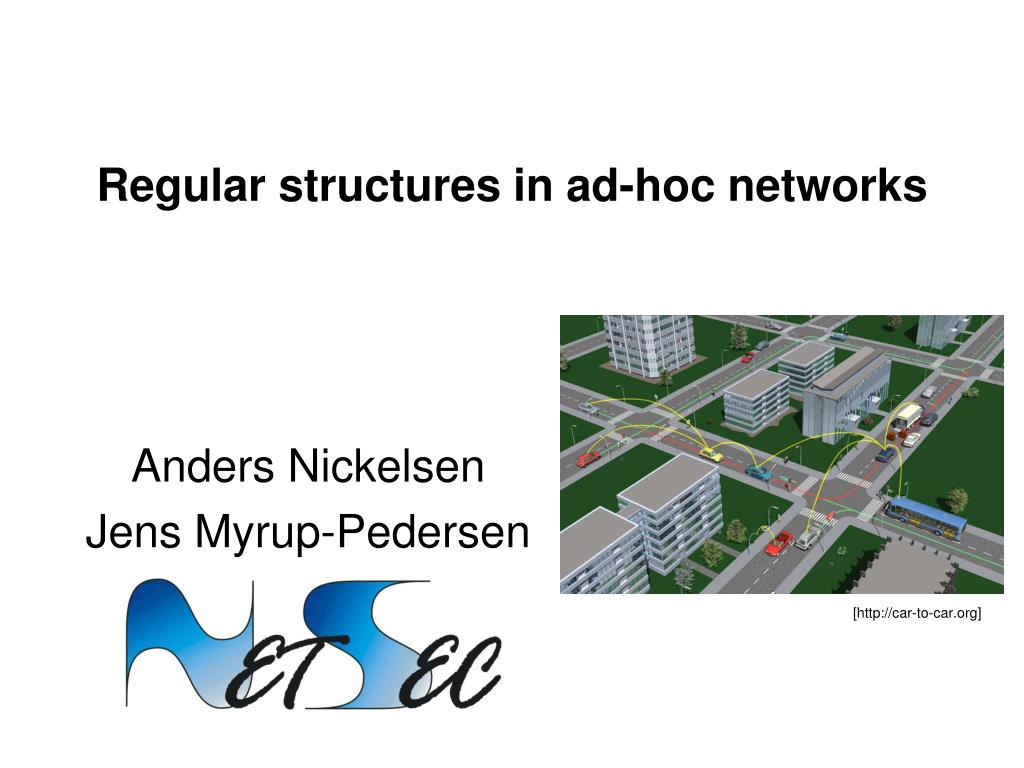
  1. Regular structures in ad-hoc networks Anders Nickelsen Jens Myrup-Pedersen [http://car-to-car.org]

  2. Regular structures in ad-hoc networks • Ad-hoc network are networks that are created between mobile nodes – nodes just communicate to its immediate neighbors • Dynamic, unreliable, potentially short-lived • Unpredictable in movement • Ad-hoc networks created by cars (car-to-car networking) have node-movement restrictions – due to roads • Still difficult to create efficient algorithms for ad-hoc networks • Regular structures (N2R, cordal rings, ...) are used in fixed networks (e.g. fiber) and have efficient algorithms (broadcasting, routing, fault-tolerance...) • Project: • Use node placement and movement knowledge (or estimates of it) to create regular structures for ad-hoc network • With mobility • Without mobility