Probability
This document provides a comprehensive overview of key probability concepts from chapters 13, 14, and 15, focusing on sample spaces and various probability rules. It explains the sample space, which is the set of all possible outcomes in an experiment, using simple examples like rolling dice and drawing cards. The text covers critical probability rules such as the Complement Rule, the Addition Rule for disjoint events, the Multiplication Rule, and the concept of independence between events. Perfect for students and enthusiasts seeking clarity in probability theory.

Probability
E N D
Presentation Transcript
Probability Notes and Questions on Chapters 13,14,15
Sample Space The Sample Space, denoted S, of an experiment is a listing of all possible outcomes. • The sample space of rolling a die once has 6 elements, that is {1,2,3,4,5,6} • The sample space of picking a card from a standard deck has 52 elements since there are 52 cards in a standard deck. • The sample space of rolling a pair of dice once has 36 elements, since each die has 6 faces.
Probability and100% Rule • The probability of a particular outcome or an event, denoted P(E), is the likelihood of the event. • P(E)=Number of ways of getting E divided by Number of all possible outcomes of the experiment • The probabilities of individual outcomes in the sample space S add up to 100%!
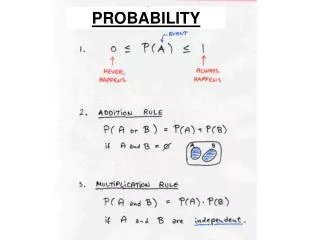
Complement Rule • Probability of an event E not happening is therefore • P(not E) = 100% - P(E) • P(at least one) = 100% - P(none) • Remember, 100% = 1. You can use either one, but don’t make the mistake such as 100%-0.4=99.6%; the correct answer should be 0.6.
Or/And Rule • Probability of an event A or an event B happening is given by • P(A or B) = P(A) + P(B) – P(A and B) • Here “A or B” means at least one of A or B happens; “A and B” means both A and B happen.
Addition Rule for Disjoint Events • On the other hand, if there are a number of mutually disjoint (i.e, no two to happen simultaneously) outcomes to an event E, then the probability of E is given by • P(E) = P(Outcome1) + P(Outcome2) + … • Example: Finding the probability of making an A, a B, or a C in a math class. • Example: Finding the probability of rolling a 3 or 4 on a single roll of the die.
Multiplication Rule • If there are a number of steps to the occurrence of an event E, then the probability of the event E is given by • P(E) = P(Step1) * P(Step 2) * P(Step 3) *… • Example: Finding the probability that you roll a 6 first, then a 2, and then a 3 on three rolls of a die.
Checking Independence • Two events A and B are said to be independent if whether A happens or not has no say in the subsequent likelihood of B and vice versa. • If P(A, given B)=P(A) then A and B are independent; • Or, if P(A and B) = P(A)*P(B), then A and B are independent.