Download
1 / 1
10 likes | 133 Vues
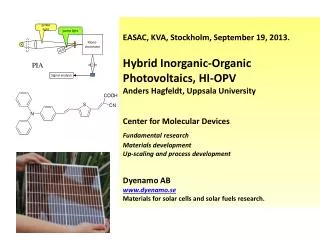
Effective surface passivation is essential for the advancement of silicon quantum dots as opto-electronic materials. Our study demonstrates that gas-phase passivation using a mixture of an alkene (styrene) and an alkyne (acetylene) results in significantly higher surface coverage and improved oxidation resistance compared to individual treatments. This phenomenon arises because the two passivating agents engage different sites on the silicon surface, suggesting a new strategy for surface passivation in silicon nanostructures by utilizing site-selective ligand mixtures.

E N D
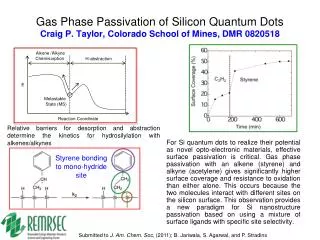
For Si quantum dots to realize their potential as novel opto-electronic materials, effective surface passivation is critical. Gas phase passivation with an alkene (styrene) and alkyne (acetylene) gives significantly higher surface coverage and resistance to oxidation than either alone. This occurs because the two molecules interact with different sites on the silicon surface. This observation provides a new paradigm for Si nanostructure passivation based on using a mixture of surface ligands with specific site selectivity. Gas Phase Passivation of Silicon Quantum DotsCraig P. Taylor, Colorado School of Mines, DMR 0820518 Alkene /Alkyne Chemisorption H-abstraction Relative barriers for desorption and abstraction determine the kinetics for hydrosilylation with alkenes/alkynes Styrene bonding to mono-hydride site E Metastable State (MS) Reaction Coordinate Submitted to J. Am. Chem. Soc, (2011); B. Jariwala, S. Agarwal, and P. Stradins