Understanding Competition and Niche Dynamics in Ecosystems
This section explores the intricate relationships between species in ecosystems, focusing on competition for limited resources. It highlights how species interact without direct confrontation, the concept of niches, and the roles organisms play in energy flow. Additionally, it discusses the importance of resource partitioning, illustrated by the Cape May Warblers feeding habits, and introduces concepts like competitive exclusion and coexistence. The interplay of predation and competition is also examined, emphasizing the contribution of biodiversity to ecosystem productivity and stability.

Understanding Competition and Niche Dynamics in Ecosystems
E N D
Presentation Transcript
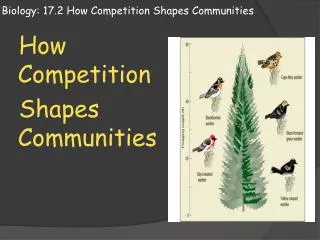
How Competition Shapes Communities EnvironementalSci pg89-92
Competition • Interaction between 2 or more species that use the same scarce resource Resources:??Can you think of limiting resources? • Most competitive interactions do not involve fighting. • Some competing species never encounter one another.
Niche • The role of a species in an ecosystem -The “job” an organism performs in the ecosystem Examples of Niches: requirements for moisture, mating, space utilization, temp. range, food consumption • Also described in terms of how the organism affects energy flow within the ecosystem • Ex. herbivore, producer
Niches and Competition • If niches overlap, there will be competition. RAWR!!!! Is competition more fierce between 2 of different or same species?
A Species’ Niche Can Vary in Size • Cape May Warbler Niche • Nests: midsummer • Eats: small insects • Where it finds food: spruce trees Fundamental Niche- entire range of conditions an organism is potentially able to occupy within an ecosystem
Dividing Resources Among Species Observation: Cape May Warblers only feed at the very top of the spruce tree???? Robert MacArthur = ecologist who studied feeding habits of 5 warbler species • All 5 species fed on insects in spruce trees (similar fundamental niches) • Each species fed at different parts of the tree (didn’t use the same resources)
Realized Niche • The part of its fundamental niche a species actually occupies Why is it beneficial for the warblers to feed at different portions of the tree? • Reduces competition
Competitive Exclusion • In nature, shortage is the rule • Species that use the same resources are almost sure to compete with one another. Competitive Exclusion- elimination of one competing species • Species that uses resource more efficiently will eventually eliminate the other
When Can Competitors Coexist? • If two species can avoid competition, they may coexist. • Even if fundamental niches overlap, if realized niches don’t overlap, both species can usually survive.
Predation Can Lessen Competition • If predators keep one species (the better competitor) in check, other species have the chance to survive. • Predation reduces competition, so promotes biodiversity. OmmNomm Nom! Amphibians are the gummy bears of the animal world.
Biodiversity 2 Components: • # different species (richness) • Relative # of each species (evenness) High biodiversity = High Productivity High biodiversity = High Stability