Exploring Dystopia: Analyzing Aldous Huxley's "Brave New World"
100 likes | 240 Vues
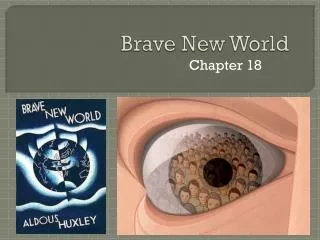
Aldous Huxley's "Brave New World," written in 1931, presents a chilling dystopian vision of the future where societal norms are taken to extremes. Set in a totalitarian state 600 years ahead, Huxley employs satire and irony to expose the folly of modern trends. Through the lens of controlled reproduction and social stratification into five classes, the story critiques the loss of individuality and free will. The introduction of John the Savage serves as a vital contrast to this seemingly perfect society, igniting questions about freedom, technology, and human values.


Exploring Dystopia: Analyzing Aldous Huxley's "Brave New World"
E N D
Presentation Transcript
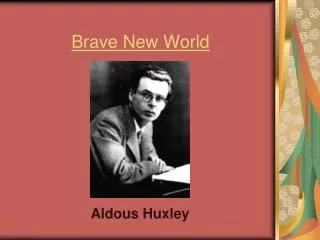
Brave New World Aldous Huxley
The Novel • Written in 1931 • Dystopian – or anti-utopian • Huxley uses satire (holding up human folly to ridicule) and irony (meaning different from intention; expectation different from result) to portray a futuristic world where many contemporary trends are taken to extremes
Utopia vs. Dystopia • Utopia • Ideal society • Perfect socio-politico-legal system • Dystopia • Opposite of Utopia • Human misery, poverty, oppression, violence, disease, and/or pollution • Anti-utopian – appears to be a utopia, but something is FATALLY wrong
Setting • London – 600 YEARS in the future • Totalitarian state • Private and public lives are regulated by the state • Free from war, hatred, poverty, disease, pain • Enjoy leisure time, material wealth, physical pleasures
Sounds good, right? • BUT, the Controllers (10 people in charge) eliminate freedoms and twist values • Standardization and progress are valued • Humans are created in factories and conditioned for specific functions • Children are raised together – mind control, sleep teaching, fulfilling destinies • as
The Five Classes • People are “bred” to fall into one of 5 classes and people are content to live out their pre-determined lives • Alpha, Beta, Delta, Gamma, Epsilon • Alphas run the factories, Epsilons do menial work
A Wrench in the Works • The Savage • A man from the uncontrolled area of the world (Indian reservation) comes to London and begins to question this society • He has freedoms that this society does not allow – free thinker • Conform or DIE
Historical Context • Post World War I • Disillusioned - futility • Years of unemployment • 1908 – Henry Ford introduces the Model-T • High demands of workers • Technology “boom” • Science making life easier, but also new means of destruction • Huxley saw this scientific progress as a vein deceit which would produce a world with no JOY
Themes • Free Will vs. Enslavement • Class Conflict • Sex • Science and Technology • Knowledge and Ignorance
Shakespeare • The novel’s title comes from The Tempest • John the Savage is drawn to Romeo and Juliet and Othello