Download
1 / 1
Amphiphilic DCDHFs as Membrane Analogs for Biological Studies
10 likes | 112 Vues
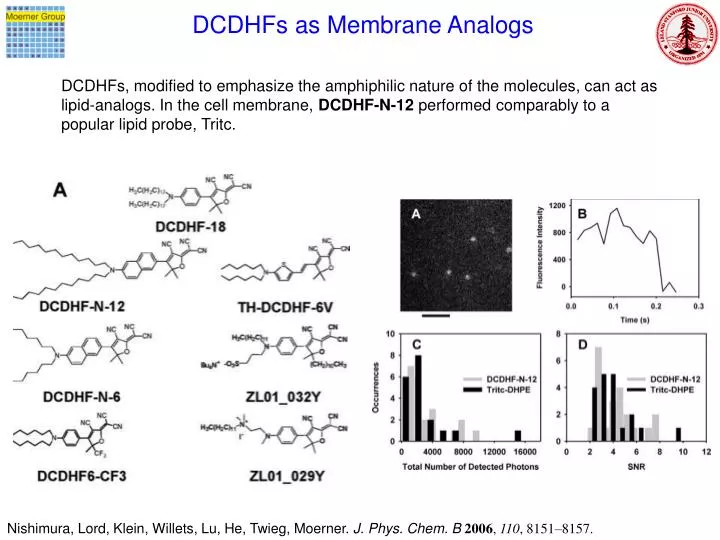
DCDHFs, modified to highlight their amphiphilic properties, serve as lipid-analogs in cell membranes. DCDHF-N-12 displayed similar performance to Tritc, a common lipid probe, in membrane studies. Research by Nishimura, et al. in J. Phys. Chem. B (2006, 110, 8151–8157).

Télécharger la présentation 
Amphiphilic DCDHFs as Membrane Analogs for Biological Studies
An Image/Link below is provided (as is) to download presentation
Download Policy: Content on the Website is provided to you AS IS for your information and personal use and may not be sold / licensed / shared on other websites without getting consent from its author.
Content is provided to you AS IS for your information and personal use only.
Download presentation by click this link.
While downloading, if for some reason you are not able to download a presentation, the publisher may have deleted the file from their server.
During download, if you can't get a presentation, the file might be deleted by the publisher.
E N D
Presentation Transcript
DCDHFs as Membrane Analogs DCDHFs, modified to emphasize the amphiphilic nature of the molecules, can act as lipid-analogs. In the cell membrane, DCDHF-N-12 performed comparably to a popular lipid probe, Tritc. Nishimura, Lord, Klein, Willets, Lu, He, Twieg, Moerner. J. Phys. Chem. B2006, 110, 8151–8157.







More Related