Exploring Eigenfaces: A Comprehensive Database and Methodology for Facial Recognition
This detailed study examines the Eigenfaces method for facial recognition, showcasing a robust database comprising 7,562 images of 3,000 individuals from the MIT Media Lab. The work emphasizes various techniques, including photometric stereo and spherical harmonics for reconstructing 3D models from images. It discusses the strengths of PCA and ROC curve analysis in recognition performance. By exploring empirical studies and mathematical foundations, this research aims to enhance understanding of facial recognition technologies and their applications in diverse fields.

Exploring Eigenfaces: A Comprehensive Database and Methodology for Facial Recognition
E N D
Presentation Transcript
Eigenfaces Photobook/Eigenfaces (MIT Media Lab)
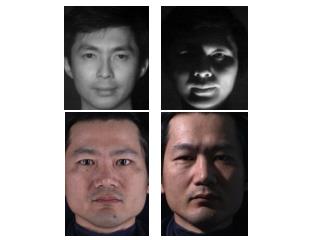
Database Photobook/Eigenfaces (MIT Media Lab) 7562 pictures of 3000 people
Query Example Photobook/Eigenfaces (MIT Media Lab)
Eigenfeatures Photobook/Eigenfaces (MIT Media Lab)
Eigenfeatures Photobook/Eigenfaces (MIT Media Lab)
Eigenfeatures Photobook/Eigenfaces (MIT Media Lab)
Eigenfeatures Photobook/Eigenfaces (MIT Media Lab) Receiver Operating Characteristic (ROC) Curve
Recognition with PCA Amano, Hiura, Yamaguti, and Inokuchi; Atick and Redlich;Bakry, Abo-Elsoud, and Kamel;Belhumeur, Hespanha, and Kriegman;Bhatnagar, Shaw, and Williams; Black and Jepson; Brennan and Principe;Campbell and Flynn; Casasent, Sipe and Talukder;Chan, Nasrabadi and Torrieri;Chung, Kee and Kim; Cootes, Taylor, Cooper and Graham; Covell; Cui and Weng;Daily and Cottrell;Demir, Akarun, and Alpaydin;Duta, Jain and Dubuisson-Jolly; Hallinan; Han and Tewfik; Jebara and Pentland;Kagesawa, Ueno, Kasushi, and Kashiwagi;King and Xu;Kalocsai, Zhao, and Elagin; Lee, Jung, Kwon and Hong; Liu and Wechsler;Menser and Muller;Moghaddam;Moon and Philips; Murase and Nayar; Nishino, Sato, and Ikeuchi;Novak, and Owirka;Nishino, Sato, and Ikeuchi;Ohta, Kohtaro and Ikeuchi; Ong and Gong; Penev and Atick; Penev and Sirivitch;Lorente and Torres;Pentland, Moghaddam, and Starner;Ramanathan, Sum, and Soon; Reiter and Matas; Romdhani, Gong and Psarrou;Shan, Gao, Chen, and Ma;Shen, Fu, Xu, Hsu, Chang, and Meng;Sirivitch and Kirby; Song, Chang, and Shaowei; Torres, Reutter, and Lorente;Turk and Pentland;Watta, Gandhi, and Lakshmanan;Weng and Chen; Yuela, Dai, and Feng; Yuille, Snow, Epstein, and Belhumeur;Zhao, Chellappa, and Krishnaswamy;Zhao and Yang.
Lambertian Reflectance • Matt surface • Light source is distant • Light reflected equally to all directions q or
Photometric Stereo: Factorization • M is f x p (#images x #pixels) • L is f x 3 – light sources • S is 3 x p – surface normals (scaled by albedo) • Rank(M)=3 (if no noise present) • SVD: • Ambiguity Eliminate by forcing integrability
Illumination Cone =0.5* +0.2* +0.3*
Intuition lighting reflectance
Spherical Harmonics • Orthonormal basis for functions on the sphere • n’th order harmonics have 2n+1 components • Rotation = phase shift (same n, different m) • In space coordinates: polynomials of degree n • Funk-Hecke convolution theorem
Spherical Harmonics 1 Z X Y XY XZ YZ
Cumulative Energy (percents) N
Other Low-D Approximations (Ramamoorthi)
r Harmonic Images
Reconstruction Reconstruction Laser scan
Advantage of Our Method Residue Std intensity Disparity error Disparity error Assuming brightness constancy Accounting for illumination variation