Understanding the Research Process: A Guide to Effective Inquiry and Analysis
The research process begins with curiosity and the art of questioning, often guided by the 5 W's—who, what, where, when, and why. This comprehensive guide outlines the fundamental types of research, including primary and secondary methods, and emphasizes the importance of developing a clear thesis statement. From selecting a subject and conducting preliminary research to drafting and revising your work, each step is crucial for building a coherent argument. Master the skills needed to gather evidence and present your findings effectively.

Understanding the Research Process: A Guide to Effective Inquiry and Analysis
E N D
Presentation Transcript
Research • What is the first thought that comes into your mind when you hear the word research? • What do you do when you first meet someone? • You engage in conversation • You usually ask questions using the 5 W’s • Research is the process of asking questions. • You have the basic skills needed to be a good researcher
Types of Research Primary Secondary Involves gathering and analyzing the results of other people’s primary research • Involves generating new ideas and information on your own • Conducting an experiment • Questionnaire • Interview
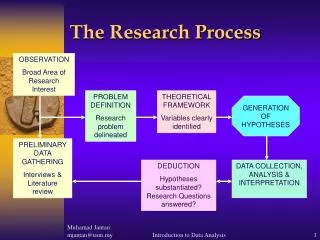
The Research Process • Choose your subject • Do preliminary research • Limit your subject to a specific topic • Find an angle and write a statement of controlling purpose – thesis statement • Prepare a list of sources • Take notes • Organize notes into an outline • Write a first draft • Revise draft • Write final draft • Works Cited
Thesis Statement • What is a thesis statement? • tells the reader how you will interpret the subject or topic • tells the reader what to expect from the rest of the paper. • is an interpretation of a question or subject, not the subject itself. • The subject, or topic, of an essay might be Colonial times or the American Revolution; a thesis must then offer a way to understand the subject • makes a claim that others might dispute. • is usually a single sentence somewhere in your first paragraph that presents your argument to the reader. • The rest of the paper, the body of the essay, gathers and organizes evidence that will persuade the reader of the logic of your interpretation
Fever 1793 Thesis Statements • Yellow fever epidemic of 1793 was one of the worst epidemics in Philadelphia history because of its mysterious cause, tenacious symptoms and economic impact. • Dr. Benjamin Rush was one of the most famous doctors of the time because of his medical experience, his use of controversial treatments and the lack of publicity regarding his failures. • French doctors had the most effective treatment of yellow fever because of less invasive procedures, knowledge of sanitary care and reliance on statistics of success. • Greater success in fighting the war against yellow fever could have been achieved through improved education of doctors, better hospitals, and improving treatments. • Several factors and conditions contributed to the fact that the Free African Society was the one and only group to step forward and offer its services during the epidemic.