Understanding Mitosis: Key Concepts and Cell Cycle Regulation
350 likes | 470 Vues
This lesson focuses on the stages of mitosis and the regulation of the cell cycle. Students will review the number of chromosomes in human somatic cells and how chromatids behave during cell division. Key concepts include the distinctions between eukaryotic and prokaryotic cell division, the significance of checkpoints in the cell cycle, and the processes of cyclin-dependent kinases (Cdks) and maturation-promoting factor (MPF). We will also discuss cancer cells and their disregard for normal cell cycle regulations, leading to excessive division.


Understanding Mitosis: Key Concepts and Cell Cycle Regulation
E N D
Presentation Transcript
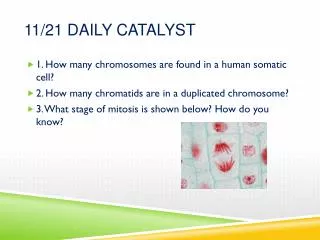
11/21 Daily Catalyst • 1. How many chromosomes are found in a human somatic cell? • 2. How many chromatids are in a duplicated chromosome? • 3. What stage of mitosis is shown below? How do you know?
11/21 Daily Catalyst Answers • 1. How many chromosomes are found in a human somatic cell? • 46 (23 from mom and 23 from dad) • 2. How many chromatids are in a duplicated chromosomes? • Two • 3. What stage of mitosis is shown below? How do you know? • Anaphase, chromatids are pulled APART
11/21 Class Business • “We are the change” extra credit due Friday • GATTACA essay due the Monday after Fall Break • Mitosis, cancer, and checkpoint quiz TOMORROW • Mitosis and meiosis quiz on Monday when we return!
Which Thanksgiving food has grandchildren? • The GRAN-berry sauce
11/21 Agenda • Daily Catalyst • Class Business • Agenda • Objective • Mitosis review • Binary fission, checkpoints, and cancer notes
11/21 Objective • Review the stages of Mitosis and discuss methods of cell regulation.
Binary Fission • What type of cells undergo mitosis? • Eukaryotic- plants and animal cells • What about bacteria? • Key Point #1: • Prokaryotes reproduce by binary fission • Meaning “division in half”
Binary Fission • Bacterial DNA is circular in shape • Bacterial DNA must be replicated before cell division • Replication begins at the Origin of Replication • A specific site on the chromosome • The origins move to opposite end of the cell • The cell begins to elongate • The plasma membrane grows inward and forms two new cells
Cell Cycle regulation • Read page. 238
Cell Cycle regulation • There is evidence towards cytoplasmic signals that control the cell cycle. • Key Point #1: • Cell cycle control system: an operating set of molecules in the cell that both trigger and coordinates key events • Regulated at certain checkpoints • (Like a dishwashing machine)
Cell Cycle regulation • Key Point #2: • Checkpoint: a control point where stop and go signals regulate • Checkpoints register signals form inside and outside the cell if the cell cycle should proceed • 3 checkpoints: G1, G2, and M phase
Cell Cycle regulation • G1 check point: • AKA the “restriction point” • Most important • Go: complete G1, S, G2, and M phases • Stop: Exit the cycle and switch into a non dividing state (G0) • Most cells are in the G0 phase • Mature nerve cells do no need to divide
Cell Cycle regulation • Cyclin-dependent Kinases (Cdks): • Activate or inactivate other proteins • Checkpoint at G1 and G2 • Cyclin: cyclically fluctuating concentration • Kinase: activate or inactivate proteins by giving them a phosphate group
MPF • MPF: maturation-promoting factor • M-phase promoting factor • Triggers the cell’s passage past the G2 checkpoint into M phase • When cyclin is high during G2, this causes MPF to phosphorylates other proteins. • During anaphase, MPF switches itself off
PDGF • Made by platelets • PDGF binds to a receptor and this triggers G1 checkpoint and get ready to divide • IN HEALING!
Cancer • Cancel cells do not heed the normal signals that regulate the cell cycle. They divide excessively and invade other tissues. If unchecked, they can kill organisms.
Cancer • Cancer cells do not stop dividing when growth factors are depleted. • Cancer cells may make their own growth factors!
Process of a cancerous cell • Cell • Transformation: a normal cell converts into a cancer cell • Immune system will cell the transformed cell, if not, the cell will rapidly divide and form a tumor • Benign tumor: not dangerous tumor • Malignant tumor: invasive and starts to impair normal function (cancer) • Cancer cells metastasize: spread from original location
11/22 Daily Catalyst • 1. • 2. • 3.
11/22 Class Business • “We are the change” extra credit due TODAY • GATTACA essay due the Monday after Thanksgiving • Test Corrections due the Monday after Thanksgiving • Mitosis/Meiosis packet due the Monday after Thanksgiving • Mitosis/Meiosis quiz on Monday • Exam #4: • Average: 1.09 • Top Scorer: Andrea • Honorable Mention: Saisha
11/22 Class Business • “We are the change” extra credit due TODAY • GATTACA essay due the Monday after Thanksgiving • Test Corrections due the Monday after Thanksgiving • Mitosis/Meiosis packet due the Monday after Thanksgiving • Mitosis/Meiosis quiz on Monday • Exam #4: • Average: 1.8 • Top Scorer: Blake (3.7) • Honorable Mention: Manahil, Ramon, Talha, Tyler B., Leyan, Ricky, Estephany
What do you call a Thanksgiving turkey mixed with an office message? • A turkey dinner with all of the FAXING’s
11/22 Agenda • Daily Catalyst • Class Business • Mitosis review • Finish cell regulation and cancer notes • Review • Quiz • Grade and track data • Anthony and Lawrence • HAVE AN AMAZING THANKSGIVING BREAK!
Mitosis Review • Label each picture of mitosis:
Cell Cycle regulation • Cyclin-dependent Kinases (Cdks): • Activate or inactivate other proteins • Checkpoint at G1 and G2 • Cyclin: cyclically fluctuating concentration • Kinase: activate or inactivate proteins by giving them a phosphate group
MPF • MPF: maturation-promoting factor • M-phase promoting factor • Triggers the cell’s passage past the G2 checkpoint into M phase • When cyclin is high during G2, this causes MPF to phosphorylates other proteins. • During anaphase, MPF switches itself off
PDGF • Made by platelets • Helpful in creating new blood vessels • PDGF binds to a receptor and this triggers the G1 checkpoint • The cell gets to “skip” the G1 checkpoint • IN HEALING! • Cuts healing time in half!
Cancer • Cancel cells do not heed the normal signals that regulate the cell cycle. They divide excessively and invade other tissues. If unchecked, they can kill organisms.
Cancer • Cancer cells do not stop dividing when growth factors are depleted. • Cancer cells may make their own growth factors!
Process of a cancerous cell • Cell • Transformation: a normal cell converts into a cancer cell • Immune system will cell the transformed cell, if not, the cell will rapidly divide and form a tumor • Benign tumor: not dangerous tumor • Malignant tumor: invasive and starts to impair normal function (cancer) • Cancer cells metastasize: spread from original location
Partner Review • Directions: Take this time to review with a partner sitting near you. You may use your textbook and notes to review. • Time: 10 minutes • Noise: 1 (partner)
Quiz • 1. Interphase • 2. Prophase • 3. Metaphase • 4. Anaphase • 5. Telophase • 6. Cytokinesis • 7. a • 8. c • 9. b • 10. a • 11. b • 12. c • 13. a • 14. a • 15. c
30/30 100% 4.0 A • 28/30 93% 3.6 A • 26/30 87% 3.3 B • 24/30 80% 2.5 B • 22/30 73% 1.8 C • 20/30 67% 1.2 D • 18/30 60% .5 F • 16/30 53% .2 F