Trapped radiation models
This study presents an overview of Earth's Van Allen radiation belts and the dynamics of trapped radiation, including cosmic rays and solar energetic particles. Focus is given to the motion of charged particles through gyration, bounce, and drift, utilizing models like NASA’s AP-8 and AE-8. Key phenomena like the South Atlantic Anomaly and the geomagnetic field's variations are discussed. The research aims to improve understanding of trapped particle populations and the effects of solar cycles and seasonal changes on radiation exposure, highlighting current modeling challenges.

Trapped radiation models
E N D
Presentation Transcript
Trapped radiation models D. Heynderickx Belgisch Instituut voor Ruimte-Aëronomie Ringlaan 3, B-1180 Brussel D.Heynderickx@oma.be
Earth’s Van Allen belts Galactic cosmic rays Solar energetic particles Secondary (albedo) radiation Radiation belts
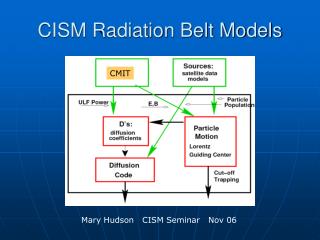
Charged particle trapping • Particle motion: gyration, bounce, drift • Guiding centre approximation: McIlwain’s (B,L) coordinates • Model description: J(E,B,L)
The South Atlantic Anomaly • Low altitude part of radiation belts • Tilt and shift of geomagnetic field: Fraser-Smith, Rev. Geophys., 25, 1, 1987 • Interaction with neutral atmosphere http://www.spenvis.oma.be/spenvis/help/background/magfield/cd.html
Trapped proton variability • Seasonal • Secular variation of geomagnetic field • Impulsive • Solar cycle
Secular variation AP-8 MIN SAMPEX/PET Directional proton flux >18 MeV at 500 km
CRRESELE Equatorial L profiles Parametrized in terms of Ap15: 15 day average of Ap
Available models • De facto standard models: NASA AP-8 and AE-8 • Advantages of the NASA models: • Widespread usage (heritage) • Full spatial coverage and energy range • Disadvantages of the NASA models: • Represent radiation environment of the 60’s and 70’s • Static models (but probably ok for long time averages) • Contamination by Starfish electrons • Other models: • CRRESPRO, CRRESELE • NOAAPRO • POLE • SAMPEX/PET
Replacement of AP-8 and AE-8 • New models do not have sufficient spatial and/or temporal coverage and/or energy range • Incomplete energy range can lead to misleading effects estimations
Standardisation efforts • COSPAR Panel for Radiation Belt Environment Modeling (PRBEM) http://wwwe.onecert.fr/craterre/prbem/ • NASA working group meeting: • Focus efforts on selected regions of space and energy ranges to expedite AP-8 and AE-8 replacement • POLE model for GEO • SAMPEX/PET+NOAAPRO for LEO protons • ONERA/LANL GPS modelling for MEO • RERMM study: use data from different satellites + Salammbô numerical simulation to produce ‘ad hoc’ models