Quadrilaterals: Properties and Relationships
Learn about parallelograms, trapezoids, and quadrilaterals, their definitions, properties, and important formulas. Explore the sum of interior angles, types of parallelograms, diagonal properties, and solving geometric problems.

Quadrilaterals: Properties and Relationships
E N D
Presentation Transcript
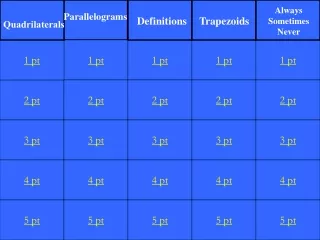
Always Sometimes Never Parallelograms Definitions Trapezoids Quadrilaterals 1 pt 1 pt 1 pt 1 pt 1 pt 2 pt 2 pt 2 pt 2 pt 2 pt 3 pt 3 pt 3 pt 3 pt 3 pt 4 pt 4 pt 4 pt 4 pt 4 pt 5 pt 5 pt 5 pt 5 pt 5 pt
1 pt What is the sum of the interior angles of a quadrilateral?
1 pt Answer: 360 Degrees
2 pt What is true about consecutive angles of a rhombus?
2 pt Answer: They are SUPPLEMENTARY
3 pt What is the equation used to find the length of a median of a trapezoid?
3 pt Answer:
4 pt What is a quadrilateral called with congruent diagonals that are not perpendicular?
4 pt Answer: RECTANGLE
5 pt What is a quadrilateral called with diagonals that are angle bisectors but they are not congruent?
5 pt Answer: A Rhombus
1 pt What are four of the five properties of a parallelogram?
1 pt • Answer: • Opposite sides are parallel • Opposite sides are congruent • Opposite angles are congruent • Diagonals bisect one another • Consecutive angles are supplementary
2 pt What type of parallelogram ALWAYS has the following property? (you may have more than one answer) Diagonals bisect each other
2 pt Answer: Parallelogram, Rectangle, Rhombus, and Square
3 pt The perimeter of a rectangle is 40cm. The length is 4cm longer than the width. What are the measures of the length and the width?
3 pt Answer: Width=8cm Length=12cm
4 pt What is the length of the diagonal of a square who’s area is 100 square inches?
4 pt Answer: inches or 14.14 inches
5 pt The perimeter of the rhombus is 128 inches. One diagonal is 30 inches. Find the length of the other diagonal.
5 pt Answer: Approx. 56.6 inches
1 pt How is a rhombus different from a parallelogram?
1 pt Answer: A rhombus always has four congruent sides. And, its diagonals are perpendicular to each other and they are angle bisectors.
2 pt Can a rectangle ever be a rhombus? Why or why not?
2 pt Answer: Yes because a SQUARE has the properties of both a rectangle and a rhombus.
3 pt What makes a trapezoid different from a parallelogram?
3 pt Answer: A trapezoid has only one set of parallel sides.
4 pt What type of quadrilaterals will always have congruent diagonals?
4 pt Answer: Rectangles and squares
5 pt The vertices of a quadrilateral are located at (10,4), (10,8), (-4,8), and (-4,4) in this order. Is this a parallelogram, rectangle, rhombus, or a square? Please be as specific as possible.
5 pt Answer: It is a parallelogram and a rectangle
1 pt What is true about the angles in a trapezoid that share a leg?
1 pt Answer: They are supplementary
2 pt What are the congruent sides called in an isosceles trapezoid?
2 pt Answer: Legs
3 pt One of the bases of a trapezoid is 15ft long. The other base is 28ft long. How long is the median?
3 pt Answer: 21.5 ft
4 pt The median of a trapezoid is 31 inches long. One of the bases is 17 inches long. How long is the other base?
4 pt Answer: 45inches
5 pt ABCD is a trapezoid with a median EX. EX=x+5 and CD+AB=4x+6. How long is the median?
5 pt Answer: 7
1 pt A square is a parallelogram.
1 pt Answer: ALWAYS
2 pt Consecutive angles of a rectangle are supplementary.
2 pt Answer: ALWAYS
3 pt The diagonals of a rectangle are angle bisectors.
3 pt Answer: SOMETIMES
4 pt A quadrilateral has only two right angles.
4 pt Answer: SOMETIMES
5 pt A rhombus has consecutive sides that are perpendicular.