Understanding Mixtures, Earth's Cycles, and Atmospheric Science
Dive into an engaging exploration of mixtures, Earth’s systems, and atmospheric science. This quiz-style format touches on critical concepts such as suspensions, heterogeneity, and the effects of greenhouse gases. Learn about tectonic movements, volcanoes, and the layers of the atmosphere, while also uncovering the intricacies of energy cycles within ecosystems. Ideal for students in Earth and Science studies, this educational resource presents a comprehensive overview of fundamental principles that govern our planet's structure and its interactions with the atmosphere.


Understanding Mixtures, Earth's Cycles, and Atmospheric Science
E N D
Presentation Transcript
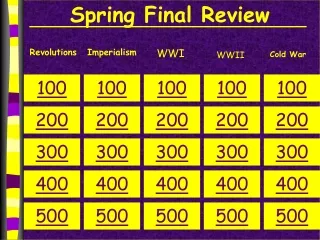
Mixtures Earth Science Atmosphere & Climate Energy & Cycles Fifield’s Choice Astronomy Categories $100 $100 $100 $100 $100 $100 $200 $200 $200 $200 $200 $200 $300 $300 $300 $300 $300 $300 $400 $400 $400 $400 $400 $400 $500 $500 $500 $500 $500 $500 IPS
$100 A: The type of mixture that separates into 2 layers when left undisturbed. Flour-water is an example.
$100 Q: What is a suspension?
$200 A: The type of mixture that looks uniform throughout, such a sugar-water.
$200 Q: What is a homogenous mixture? (or, what is a solution?)
$300 A: The process used to separate solid particles from water particles, in a mixture like flour-water, where the solid is insoluble.
$300 Q: What is filtering?
$400 A: In a solution, it is the substance being dissolved.
$400 Q: What is a solute?
$500 A: The type of mixture that is “different throughout”, such as oil-water which forms 2 distinct layers.
$500 Q: What is a heterogeneous mixture?
$100 A: The number of seismograph stations needed to locate the epicenter of an earthquake.
$100 Q: What is three (3)? http://mail.colonial.net/~hkaiter/earthquakes.html
$200 A: The type of plate boundary where two tectonic plates are moving apart from one another.
$200 Q: What is a divergent boundary? http://geology.com/nsta/divergent-plate-boundaries.shtml
$300 A: The type of crust that will subduct when continental and oceanic crust come together.
$300 Q: What is oceanic? http://www.platetectonics.com/book/page_12.asp
$400 A: The type of volcano that has smooth, flowing eruptions and gently sloping sides.
$400 Q: What is a shield volcano? http://volcanoes.usgs.gov/images/pglossary/ShieldVolcano.php
$500 A: The type of rock that is formed when an existing rock is exposed to great amounts of heat and/or pressure.
$500 Q: What is a metamorphic rock? http://www.minimegeology.com/home/mgeo/page_77_22/slate_metamorphic_rock.html
$100 A: The atmospheric layer that contains ozone.
$100 Q: What is the stratosphere? http://science.howstuffworks.com/nature/climate-weather/atmospheric/weather3.htm
$200 A: The temperature will do this as you move higher in the troposphere.
$200 Q: What is decrease? http://www.wyckoffschools.org/eisenhower/teachers/chen/atmosphere/earthatmosphere.htm
$300 A: Towards the shore or away from the shore, the direction that coastal breezes blow in the afternoon.
$300 Q: What is towards the shore? http://www.prh.noaa.gov/hnl/kids/activities.php
$400 A: The name of the situation that occurs when warm air near Earth’s surface becomes trapped beneath a layer of cool air; it often traps pollution in our valley
$400 Q: What is a temperature inversion? http://www.windows2universe.org/milagro/air/transport.html
$500 A: Earth’s early atmosphere was considered to be composed of these two elements.
$500 Q: What are hydrogen and helium? http://www.crikey-adventure-tours.com/stromatolites.html
$100 A: The type of reaction that releases energy from the system to the surroundings.
$100 Q: What is an exothermic reaction? http://www.saskschools.ca/curr_content/chem30_05/1_energy/energy2_1.htm
$200 A: Plants give this off when they photosynthesize.
$200 Q: What is oxygen? http://myweb.cwpost.liu.edu/vdivener/notes/solid-liquid-gas.htm
$300 A: Combustion from fossil fuel-burning engines adds this carbon-compound to the atmosphere.
$300 Q: What is carbon dioxide (CO2)? http://boomeria.org/grades/demos/methane.html
$400 A: Water evaporates from plants during this process of the water cycle.
$400 Q: What is transpiration? http://keep3.sjfc.edu/students/amm03205/e-port/Transp.html
$500 A: These are buried deep beneath earth’s crust forming coal, oil and gas.
$500 Q: What are fossil fuels?
$100 A: As more carbon dioxide is released into the air heat is trapped, causing this effect.
$100 Q: What is the greenhouse effect? https://marchantscience.wikispaces.com/envikt
$200 A: Between the inner and outer planets, the ones that are gaseous. http://www.universetoday.com/15451/the-solar-system/
$200 A: What are the outer planets?
$300 A: The tectonic plates are made out of this; it is composed of the crust and upper layer of the mantle.
$300 Q: What is the lithosphere? http://astronomyonline.org/SolarSystem/EarthGeography.asp
$400 A: The type of galaxy known as the Milky Way.