01 / 81Flavor oscillation and CP violation Quark mixing and the CKM matrix
1 / 17
Télécharger la présentation
Flavor oscillation and CP violation Quark mixing and the CKM matrix
Une image / un lien ci-dessous est fourni (tel quel) pour télécharger la présentation
Politique de téléchargement : le contenu du site vous est fourni TEL QUEL pour votre information et votre usage personnel ; il ne peut être vendu, concédé sous licence ni partagé sur d’autres sites sans l’accord de son auteur.Le contenu vous est fourni TEL QUEL, pour votre information et votre usage personnel uniquement.Téléchargez la présentation en cliquant sur ce lien.Lors du téléchargement, si vous ne parvenez pas à télécharger une présentation, l’éditeur a peut-être supprimé le fichier de son serveur.Pendant le téléchargement, si vous ne parvenez pas à obtenir une présentation, le fichier a peut-être été supprimé par l’éditeur.
F I N
Plus de contenu associé
Transcription de la présentation
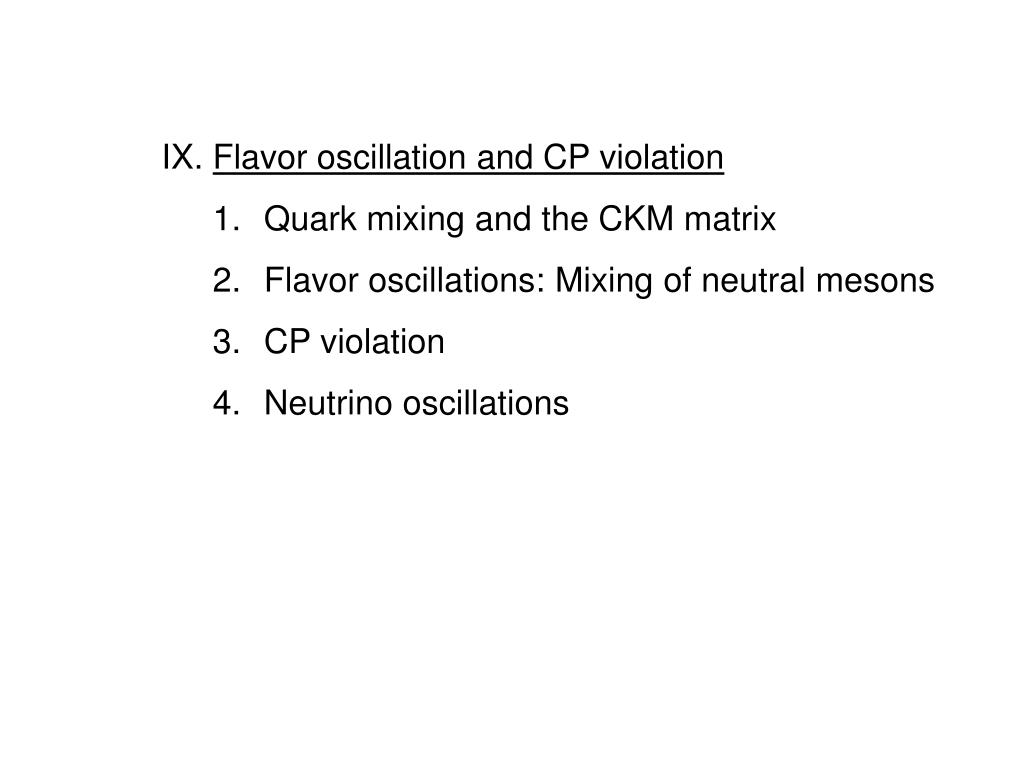
Flavor oscillation and CP violation • Quark mixing and the CKM matrix • Flavor oscillations: Mixing of neutral mesons • CP violation • Neutrino oscillations
Unobservable Phases Phases of left-handed fields in Jcc are unobservable: possible redefinition Real numbers Under phase transformation: 5 unobservable phase differences !
d s b u C t Magnitude of elements komplex in O(3) , A, , , = 0.22 Wolfenstein Parametrization Reflects hierarchy of elements in O()
CP (T) violation i.e. Complex elements Complex CKM elements and CP violation CP T Remark: For 2 quark generations the mixing is described by the real 2x2 Cabbibo matrix no CP violation !!. To explain CPV in the SM Kobayashi and Maskawa have predicted a third quark generation.
2. Mixing of neutral mesons As result of the quark mixing the Standard Model predicts oscillations of neutral mesons: Similar graphs for other neutral mesons: Neutral mesons: 1987 1960 2007 2006 discovery of mixing
For neutral mesons consider 2 components M and Γhermitian: 2.1 Phenomenological description of mixing Schrödinger equation for unstable meson:
Neutral B mesons Mass eigenstates (by diagonalizing matrix) Parameters of the mass states Heavy and light mass eigenstate: complex coefficients Flavor eigenstates
Two mixing mechanisms: • Mixing through decays • Mixing through oscillation show different oscillation behavior CP, T- violation in mixing: In general:
„long distant, on-shell states“ „short distant, virtual states“ For K0 important, for B0 negligible Mixing mechanisms: e.g. K0
KL and KScan be identified with the mass eigenstates (ignoring CP violation) Phase convention: Large differences between lifetimes 2.2 Neutral kaons Observation of two neutral kaons KL (long) and KS(short)with different lifetimes:
Neutral kaon system After the lifetime of the Ks the K0 consists entirely out of Kl’s, which are essentially an equal mixture of K0 and K0. Expectation Initially pure K0 beam Measurement self-tagging CPLEAR
K0 - K0 (strangeness) oscillation in the SM Long range effects: difficult to calculate Short range effects Oscillation frequency m: c quark contribution dominant: although mt2 is very large, the factor |VtsVtd|2 ~ 5 is very small !
Mixing mechanisms: • Mixing through decay: many possible hadronic decays is large Significant contribution only from top loop • Mixing through oscillation Large ms,d: ms~1/2 md Bs osc. is about 35 times faster than Bd osc. 2.3 Neutral B Meson
ARGUS 1987 Discovery of B0 mixing First e+e- B factory at DESY: Unmixed: Mixed: Same charge
Phase convention: 3.1 Observation of CP violation (CPV) in KL decays Reminder: If no CPV:
If no CPV: Christenson, Cronin, Fitch, Turlay, 1964 should always decay into 3: CP(|3>)= -1 and never into 2 CP(|2>)= +1 Explanation: Not a CP eigenstate: CP violation !
1999 After 35 years of kaon physics: (mixing) (Direct CPV) Interpretation of CPV measured in the kaon system is difficult. Much easier to understand and to predict in the SM is the B meson system: CPV in the B0 system was observed in 2000.
Phase angle0: complex CKM matrix Different mixing for quarks and anti-quarks Origin of CP Violation (CPV) Antiquarks: 3.2 CP Violation in the Standard Modell see Wolfenstein parametrization Quarks:
Phase measurement Interference experiment 3.3 Observation of CP Violation Weak and CP invariant phase difference Need two phase differences between A1 and A2: Weak difference which changes sign under CP and another phase difference (strong) which is unchanged.
weak strong 2 2 q/p p/q “3 Ways” of CP violation in meson decays a) Direct CP violation b) CP violation in mixing
CP=-1 c) CP violation in interference between mixing and decay
K0 mixing B0 decay B0 mixing c s d b d b c W+ s s d d b d d SM prediction of CP for B0→J/Ks Same for all ccK0 channels Beside Vtd all other CKM elements are real no direct CPV, no CPV in mixing
Interference = sin2 for B0J/KS indicates direct CP violation if |q/p|1 Calculation of the time-dependent CP asymmetry negligible Time resolved
To measure CP violation in Bd system: • Need many B (several 100 109) • Need to know the flavor of the B at t=0 • Need to reconstruct the decay length to measure t
50% / 50% 3.4 Measurement of sin2: Asymmetric e+ e- B factory Symmetric: B mesons decay at rest decay length z0 Asymmetric: decay length z250m Boost = 0.56
PRL 94, 161803. • B0D*+p-fast • D0p+soft • K-p+ B0(Dt) (2S) Ks m+m- p+p- Measurement of sin2: Golden decay channel
3.5 Experimental status of the Unitarity Triangle • Standard Model CKM mechanism confirmed • Large CP Violation in B decays • Large direct CP violation observed • CPV parameter related to magnitude of non-CP observables A triple triumph
No No • CP violation in quark sector is a factor ~1010 to small. • for MHiggs> 114 GeV: Symmetry breaking = 2nd order phase transition 3.6 Baryon asymmetry in the universe Does the Standard Model explain the baryon symmetry in universe? Andrei D. Sakharov, 1967 • Baryon number violation • C and CP Violation • Departure from thermal equilibrium Attractive: Super-symmetric extensions of Standard Model • Additional CP violation through supersymmetric particles • Extended Higgs-sector strong phase transition Alternative: Lepto-genesis
New Physics W New Physics W 3.7 Flavor and CP Physics as probe for New Physics Aim: Search for New Physics in loop-processes Penguin amplitudes Box-Diagramms (oscillation) Deviation from the Standard Model Absolute rates und phase dependent CP asymmetries Complementary to the direct searches for NP by ATLAS/CMS Historical examples: GIM Mechanism, B Oscillation
Bs Future searches for New Physics Bs mixing (new phases): (visible) CP Violation in penguin decays: (visible) (visible) Precision meas. of CKM Phase : Tree Zerfälle: Loop Zerfälle: Rare deacys: T. Hurth
bb Produktion b p p inel~ 80 mb bb~ 500 b qb qb b B Meson Production at the LHC Gluon-Gluon-Fusion: • LHC • pp Kollisionen bei s = 14 TeV • Korrelierte Vorwärtsproduktion der bb • für L ~ 2 x 1032 cm-2s-1 (defokussierte Strahlen am LHCb IP): • n = 0.5 IA / BX (ATLAS 5…25) • ~1012 bb Ereignisse/Jahr • LHCb • Ein-Arm Vorwärtsspektrometer 12 mrad < < 300 mrad(1.8<<4.9)
Typisches B Ereignis in LHCb Simuliertes Ereignis • Zerfallslänge L typisch ~ 7 mm • Zerfallsprodukte p ~ 1–100 GeV • Trigger auf “low pt” Teilchen (wie Untergrund) • Physik verlangt Rekonstruktion des Zerfalls alle 25 ns
Massive neutrinos develop differently in time. for masses mi<<Ei: there will be a mixing of the flavor states with time. 4. Neutrino Oscillations For massive neutrinos one could introduce in analogy to the quark mixing a mixing matrix describing the relation between mass and flavor states: Constant for massless : mixing is question of convention
Connexion au compte
Connectez-vous pour publier votre contenu sur SlideServe.