Download
1 / 17
170 likes | 312 Vues
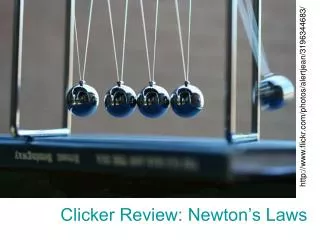
Newton's First Law of Motion, also known as the Law of Inertia, states that an object in motion remains in motion, and an object at rest stays at rest unless acted upon by an unbalanced force. This principle explains that an object will continue its state of motion unless a net force is applied. Inertia, which is related to mass, indicates that objects with more mass resist changes in their motion more than lighter ones. This law is crucial in understanding motion and is foundational in physics, influencing technologies such as automatic braking systems in cars.

E N D
6.1 Newton’s First Law pp. 138-140
NEWTON’S THREE LAWS OF MOTION • In his book, Principia, Newton described the three laws of motion. • He did not discover all three laws, he explained them in a way that many people could understand
NEWTON’S FIRST LAW OF MOTION • This is also known as the Law of Inertia • It says : An object in motion will remain in motion at a constant speed and in the same direction unless acted on by an unbalanced force. • An object at rest will remain at rest unless acted upon by an unbalanced force.
6.1 Law of inertia • Newton’s first lawsays that objects continue the motion they already have unless they are acted on by a net force. • If the net force is zero, an object at rest will stay at rest. • If an object is acted upon by unbalanced forces, its motion will change.
NEWTON’S FIRST LAW OF MOTION • In other words… • Unless you apply a force, things tend to keep on doing what they were doing in the first place. • Objects at rest (not moving) will not begin moving unless a push or pull is exerted on them.
6.1 Net force • Newton’s first law is often written in terms of the net force: • “An object at rest will stay at rest and an object in motion will continue in motion at constant velocity UNLESS there is a net force.” According to these vectors, in what direction is the net force?
6.1 Force changes motion • Forces can be used to increase or decrease the speed of an object, or to change the direction an object is moving.
NEWTON’S FIRST LAW OF MOTION • An object moving at a certain velocity will continue to move forever at that same speed and in the same direction unless an unbalanced force acts on it. • Inertia is related to mass. Mass is a measure of inertia.
NEWTON’S FIRST LAW OF MOTION • An object with a small mass has less inertia than an object with a large mass. • For example… • A tractor trailer has more mass than a motorcycle
6.1 Law of inertia • Inertia is the property of an object that resists changes in motion. • Objects with more mass have more inertia and are more resistant to changes in their motion. Which ball has more inertia?
NEWTON’S FIRST LAW OF MOTION • How do ABS (automatic brake systems) work in cars? • The system is controlled by a computer that prevents skidding by sensing when the wheels are about to lock.
ABS BRAKES EXPLAINED • The computer releases and reapplies the brakes up to 25 times a second. Instead of skidding out of control, the car slows down and stops safely.
Solving Problems A car drives along the highway at constant velocity. Find the car’s weight and the friction force if the engine produces a force of 2,000 newtons between the tires and the road and the normal force on the car is 12,000 N.
Solving Problems • Looking for: • …weight of car in newtons, force due to friction • Given: • …ForceN = 12,000N (up); • …ForceE = 2,000N (forward) • Relationships: • Newton’s 1st Law: • net force = zero at constant velocity; so ForceN = ForceW and ForceE = ForceF
FW = 12,000N FF = 200 N FE = 200 N FN = 12,000N Solving Problems • Solution • Draw a free body diagram. • There is no net force upward, so the weight of the car is an equal downward force of 12,000 N. • The forward engine force balances the friction force so the friction force is 2,000 N.