The Evolution and Future of Recombinant DNA Technology
This article explores the fascinating realm of recombinant DNA technology, highlighting its importance in studying genetic relationships, such as the Kermode bear's close relation to black bears. We will delve into the mechanisms of recombinant DNA, outlining how genetic material is transferred between organisms and its current applications, including insulin production and genetically modified crops. Furthermore, we will discuss the potential future uses of this technology, including gene therapy for curing genetic diseases and the ethical considerations surrounding biological warfare.

The Evolution and Future of Recombinant DNA Technology
E N D
Presentation Transcript
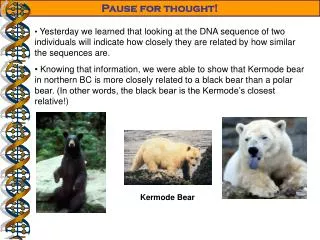
Pause for thought! • Yesterday we learned that looking at the DNA sequence of two individuals will indicate how closely they are related by how similar the sequences are. • Knowing that information, we were able to show that Kermode bear in northern BC is more closely related to a black bear than a polar bear. (In other words, the black bear is the Kermode’s closest relative!) Kermode Bear
Recombinant DNA technology What is the present and future of DNA technology?
Recombinant DNA Technology What is recombinant DNA technology? • Taking genetic information from one organism and splicing it into another. • Current uses of this technology are: • production of insulin using bacterial cultures • genetically-modified crops for agriculture • genetically-modified animals in research and agriculture. • Future uses of this technology could include: • Gene therapy to cure genetic diseases • Biological warfare with ‘superbugs’
Recombinant DNA Technology How does recombinant DNA technology work? • Extract DNA from two organisms. • Cut DNA samples with restriction enzymes. • Insert gene from one organism into the DNA of the other organism and stick together using ligases. • Insert the recombined DNA into a host and let them grow and reproduce with the recombined DNA. NOTE: The process of inserting new DNA sequences into the genome of an organism is called transformation!
Recombinant DNA Technology Where did the idea for recombinant DNA come from? • From the way that viruses replicate themselves in nature! • For viruses to reproduce they must: • Enter a host cell • Insert it’s DNA into the host DNA • Wait for the host to make the virus proteins during protein synthesis. • Put all the virus proteins together and burst out of the host cell.