Understanding Gas Laws: Kinetic Theory and Particle Behavior
90 likes | 220 Vues
This overview explores the fundamental principles of gas laws and the kinetic theory of matter. Gases consist of particles, such as molecules or atoms, which are in constant, random motion. This motion leads to elastic collisions, influencing the properties of gases: volume, temperature, and pressure. Key concepts include measuring volume in liters or milliliters, understanding temperature using the Kelvin scale, and recognizing pressure as force per area. Additionally, we highlight Avogadro’s Law, stating equal volumes of gas at the same temperature and pressure contain equal numbers of particles.


Understanding Gas Laws: Kinetic Theory and Particle Behavior
E N D
Presentation Transcript
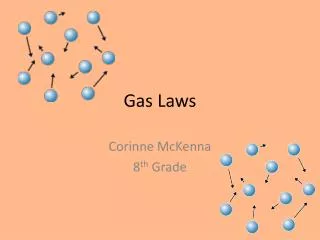
Kinetic theoryParticles of matter are in constant motion no matter the form (s, l, g) A gas is composed of particles, in the form of molecules or atoms. The particles of a gas move rapidly in constant, random motion. All collisions are perfectly elastic.
Physical behavior of a gas depends on: volume temperature pressure
Volume How much space occupied volume of a gas in a sealed container is the volume of the container gases not in sealed containers are uncontained Units can be milliliters, liters, cubic centimeters
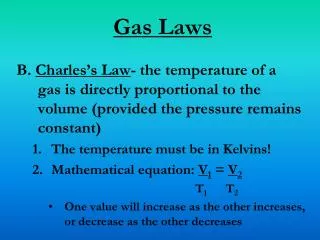
TemperatureMeasure of the average kinetic energy of particles in a substance same temperature = same average kinetic energy temperature measured using Kelvin scale Kelvin temperature = 0°C + 273 no upper limit for temperature lower limit = absolute zero 0 K = -273°C (no motion of particles)
To convert from Celsius to Kelvin—add 273 To convert from Kelvin to Celsius– subtract 273
Pressureforce per area result of simultaneous collisions of billions of gas particles units of pressure atmospheres mm Hg Torr Pascal
Standard Temperature and Pressure (STP) Standard temperature = 0°C = 273 K Standard pressure = 1 atm = 760 mm Hg = 760 Torr = 101 kPa
Avogadro’s Law equal volumes of gases at the same temperature and pressure contain equal numbers of particles at STP 1 mole (6.02 X 10²³ particles) of any gas occupies 22.4 liters