Understanding Permutations and Combinations: Counting Outfits and Arrangements
This lesson explores the concepts of probability, permutations, and combinations through practical examples. Learn how to calculate the number of different outfits you can assemble from selected clothing items, as well as determining the arrangements of contestants in a race or candidates for positions. We'll delve into the counting principle, comparing situations where order matters (permutations) versus where it does not (combinations). By the end of this lesson, you'll have a clear understanding of how these mathematical principles apply in real-world scenarios.

Understanding Permutations and Combinations: Counting Outfits and Arrangements
E N D
Presentation Transcript
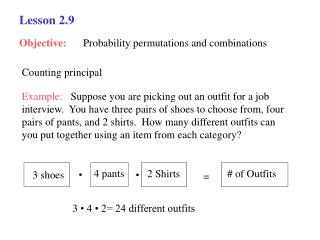
Lesson 2.9 Objective: Probability permutations and combinations Counting principal Example: Suppose you are picking out an outfit for a job interview. You have three pairs of shoes to choose from, four pairs of pants, and 2 shirts. How many different outfits can you put together using an item from each category? 4 pants 2 Shirts # of Outfits • 3 shoes • = 3 • 4 • 2= 24 different outfits
Permutations (when the order matters) Example: Six people are running in a race. The top three places get 1st, 2nd, and 3rd prize. How many arrangements are there? How many people have a shot at…. 2nd 1st 3rd 4 = 5 • 6 • 120 arrangements
Combinations: When the order does not matter Six People are running for city council. There are three positions available. How many combinations are there? Hint Use A,B,C,D,E,F for the six candidates Mathematically ACF BDE ABC BDF ADE 120 ABD = 20 6 BEF ADF ABE CDE ABF AEF CDF BCD ACD When the order does not matters, you must divide! CEF BCE ACE BCF DEF 20 DIFFERENT COMBINATIONS On test!!!!!
Example: You just bought 5 books and want to take two of them with you on vacation. How many different combinations of two books can you take? Hint: Use A,B,C,D,E for each book BC AB MATHEMATICALLY CE BD AC DE BE AD 20 = 10 2 CD AE 10 COMBINATIONS