Download
1 / 7
70 likes | 178 Vues
This overview explores the three primary patterns of dispersion in populations: clumped, uniform, and random. Clumped dispersion, the most common pattern, occurs when individuals group in patches due to factors like resource abundance and environmental conditions. This arrangement offers advantages such as increased mating opportunities and protection from predators. Uniform dispersion, less common, arises from competition and territoriality, resulting in evenly spaced individuals. Random dispersion results from independent organism placement due to the absence of strong interactions. Each pattern reveals insights into ecological dynamics.

E N D
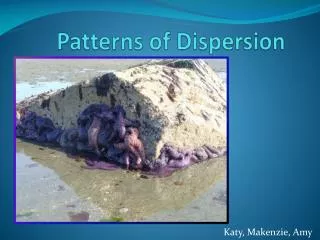
Patterns of Dispersion Katy, Makenzie, Amy
Clumped • The most common pattern of dispersion • Individuals are arranged in patches • Reasons: • Abundance of food • Environmental factors that favor growth • Benefits: • Higher number of available mates • More protection from predators • Increased effectiveness for predators that hunt
Uniform • Evenly spaced dispersion of organisms • Not very common in nature • Reasons: • Competition for resources • Social Interaction: territoriality- defense of a bounded physical space against encroachment by other individuals • Examples: • Some plants secret chemicals that inhibit germination of nearby individuals that could compete for resources • Uniform spacing is maintained by aggressive interactions between King Penguins.
Random • Each organism is independent of other organisms • Random patterns not as common as clumped dispersion • Reasons: • Absence of strong attractions or repulsions within a population • Physical or chemical factors of other organisms do not affect the dispersion pattern • Examples: • Plants growing from windblown seeds