
Projectile Motion
E N D
Presentation Transcript
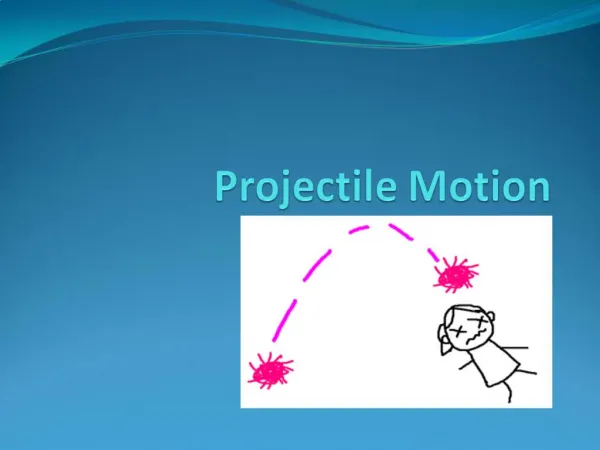
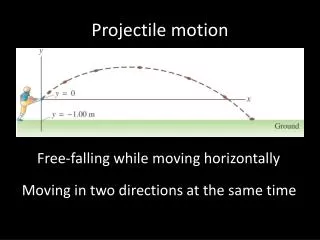
A projectile is an • object moving in 2 • dimensions under • the influence of • Earth's gravity; its • path is an upside • down parabola.
Projectile Motion • Projectile Motion Motion of an object that is projected into the air at an angle. • Near the Earth’s surface, the acceleration a on the projectile is downward and equal to a =g = 9.8 m/s2 Goal:Describe projectile motion after it starts. • Galileo:Analyzed horizontal & vertical components of motion separately. • Today: Displacement D & velocity v are vectors Components of motion can be treated separately
Projectile Motion • Simplest example:A ball rolls across a table, to the edge & falls off the edge to the floor. It leaves the table at time t = 0. Analyze the ypart of motion & the x part of motion separately. • y part of the motion: Down is positive & the origin is at table top: y0 = 0. Initially, there is no y component of velocity: vy0 = 0 vy = gt, y = (½)g t2 • x part of motion:Origin is at the table top: x0 = 0. There is NO x component of acceleration!ax = 0. Initially the x component of velocity is vx0 vx = vx0, x = vx0t
A Ball Rolls Across a Table & Falls Off • Projectiles can be understood • by analyzing horizontal • vertical motions separately. • At any point, vhas bothx& • ycomponents. Take down as • positive. Initial velocity has • an x component ONLY! That • is vy0 = 0.The kinematic • equations tell us that, at time t, • vx= vx0, vy = gt • x = vx0t • y = vy0t + (½)gt2 t = 0 here
Summary • A ball rolling across the table & falling. • Vector velocityvhas 2 components: vx = vx0 , vy = gt • Vector displacementDhas 2 components: x = vx0t , y = (½)gt2
The speed in the x direction is • constant; in they-direction the • object moves with constant • accelerationg. • The photo shows 2 balls that • start to fall at the same time. • The one on the right has an • initial speed in the xdirection. • It can be seen that the vertical • positions of the 2 balls are • identical at identical times, • while the horizontal position • of the yellow ball increases • linearly.
Projectile Motion PHYSICS • Vertical (y) part of the motion: vy = gt , y = (½)g t2 The SAME as free fall motion!! An object projected horizontally will reach the ground at the same time as an object dropped vertically from the same point! (x & y motions are independent)
Projectile Motion A common example of a projectile is a baseball!
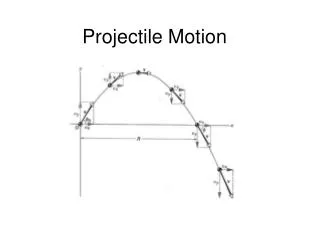
A “Somewhat General” Case • An object is launched at initial angle θ0with the horizontal. • Analysis of the motion is similar to before, except the • initial velocity has a vertical component vy0 0. • Let up be positive now!
A “Somewhat General” Case Let up be positive! Components of initial velocity v0: vx0 = v0cosθ0 vy0 = v0sinθ0 The Parabolic shape of the path is real. Acceleration = g down for the entire trip!
General Case: Take y positive upward& origin at the point where it is shot: x0 = y0 = 0 vx0 = v0cosθ0, vy0 = v0sinθ0 • Horizontal Motion: No Acceleration in the x Direction! vx = vx0 , x = vx0 t • Vertical Motion: vy = vy0 - gt, y = vy0 t - (½)g t2 (vy) 2 = (vy0)2 - 2gy • If yis positive down, the - signs become + signs.
Summary: Projectile Motion Projectile Motion Motion with constant acceleration in 2 dimensions, where the acceleration is g and is down.
Solving Projectile Motion Problems • Read the problem carefully, & choose the object(s) you are going to analyze. • Sketch a diagram. • Choose an origin & a coordinate system. • Decide on the time interval; this is the same in both directions, & includes only the time the object is moving with constant acceleration g. • Solve for the x and y motions separately. • Listknown & unknown quantities. Remember that vx never changes, & vy= 0at highest point. • Plan how you will proceed. Use the appropriate equations; you may have to combine some of them.
Projectile Motion Example 4.4: Rolling off a Cliff • A car rolls off a cliff of height h = 20 m. Its initial velocity is v0 = 10 m/s, along the horizontal. Calculate a. The time it takes to hit the ground at the base after it leaves the cliff. b. Its horizontal distance x from the base when it hits the ground. c. Its velocity when it hits the ground.
A movie stunt driver on a motorcycle speeds horizontally off a 50 m high cliff. How fast must the motorcycle leave the cliff top to land on level ground below, 90 m from the base of the cliff where the cameras are? Example: Driving off a cliff!! vx = vx0 = ? vy = -gt x = vx0t, y = - (½)gt2 y is positive upward, y0 = 0at top. Also vy0 = 0
A movie stunt driver on a motorcycle speeds horizontally off a 50 m high cliff. How fast must the motorcycle leave the cliff top to land on level ground below, 90 m from the base of the cliff where the cameras are? Example: Driving off a cliff!! vx = vx0 = ? vy = -gt x = vx0t, y = - (½)gt2 Time to bottom: t = √2y/(-g) = 3.19 s vx0 = (x/t) = 28.2 m/s y is positive upward, y0 = 0at top. Also vy0 = 0
Example: Kicked Football • A football is kicked at an angle θ0 = 37.0°with a velocity of 20.0 m/s, as shown. Calculate:a.Max height. b. Time when hits ground. c. Total distance traveled in the x direction. d. Velocity at top. e. Acceleration at top. θ0 = 37º, v0 = 20 m/s vx0= v0cos(θ0) = 16 m/s, vy0= v0sin(θ0) = 12 m/s lllllllll