Engaging in Socratic Dialogue: Guidelines for Effective Discussion
This guide outlines the principles and guidelines for conducting Socratic discussions where participants listen to understand and engage in a meaningful exchange of ideas. Leaders are encouraged to create an inclusive environment by suspending their own beliefs, asking open-ended questions, and ensuring clarity in responses. Participants are urged to communicate effectively and focus on textual analysis, fostering a collaborative and respectful atmosphere. Emphasizing active listening and thoughtful contribution, this framework aims to deepen understanding and connection among individuals.

Engaging in Socratic Dialogue: Guidelines for Effective Discussion
E N D
Presentation Transcript
Socratic discussion “The only true wisdom is in knowing you know nothing.”
Dialogue • In dialogue, one listens to understand, to make meaning, and to find common ground • Dialogue calls for temporarily suspending one’s beliefs • Dialogue respects all the other participants and seeks not to alienate or offend
Guidelines for leaders • Set the stage • Beware of trying to be perfect • Subject matter of seminars is understanding of issues and ideas • Stay with the text • Follow every answer with another question, building upon the answer just given
Guidelines for leaders continued • Rephrase questions until they are understood • Wait for students to respond; thinking is OK • Draw out the reasons for and the implications of student’s answers • Insist that answers be clear and adequately explained • Do not insist on agreement in matters of opinion; encourage discussion of differences
Guidelines for Leaders continued • There is no need to reach resolution, compromise/synthesis or closure • Recognize listening as a form of participation • It’s OK to coach students in Socratic discussion
Guidelines for participants • Refer to the text when needed during the discussion. *Do not stay confused; ask for clarification *Stick to the point currently under discussion; make notes about ideas you want to come back to. *Don’t raise hands; take turns speaking *Listen carefully
Guidelines for participants continued • Speak up so all can hear you • Talk to each other; not just to the leader or teacher • Discuss ideas rather than each other’s opinions • You are responsible for the discussion to be a success
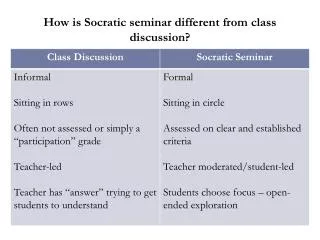
Let’s begin • Read the text silently and individually • Examine the text closely and annotate • Work with partner directly in front or behind you • Identify the Great Ideas in the text • Leader: start discussion with one of the following: Ranking, How, or Generic question.
Discussion begins • Inner circle begins discussion based on the leader’s question • Guidelines for participants followed • Leader follows “leader” guidelines to keep discussion on track • Leader stops discussion and presents another idea or open ended question • Inner circle discusses the new idea or question to partner in outer circle
Discussion continues • Leader asks inner circle to switch with outer circle so that new voices are heard during discussion • Remind outer circle that they can not engage in discussion but may take notes • Be open to new ideas, and personal opinions changing!
Socrates • Let him that would move the world first move himself • Socratic Seminars International: Oscar@SocraticSeminars.com • Common core Standards: RL 1.7, SL 7.a.b.c.d
mcef • Room 2 is very grateful for our new computers • Our research is focused and shared within our Google doc accounts • Vocabulary and grammar activities are interactive • We acknowledge each other’s writing and help each other become better writers • Connecting to each other and the world opens our minds to all knowledge
PTA • Thank you for making Miller a family • Back to school BBQ • Honorary service awards • Magazine drive • Corrals • Community connection