Dark Matter Halos
This research explores the evolution and characteristics of dark matter halos through advanced N-body simulations. It covers a range of topics, including cooling, heating, star formation, and metal enrichment effects within these halos. The study analyzes mass functions, clustering of dark matter halos, and their correlation with galaxy luminosity. Key findings emphasize the relationship between halo mass and galaxy morphology, as well as the impact of environment on halo characteristics. This comprehensive analysis contributes to the understanding of the dark matter-galaxy connection across cosmic epochs.
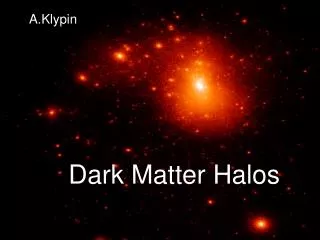

Dark Matter Halos
E N D
Presentation Transcript
A.Klypin Dark Matter Halos
GADET Springel, SDM White PKDGRAV - GASOLINE Quinn, Steidel, Wadsley, Governato, Moore ART Kravtsov, Klypin, N.Gnedin, Gottlober ENZO Bryan, Norman Major codes: • N-body • Hydro • Cooling/Heating/SF • Metal enrichment • Radiative transfer • Multistepping/Multiple masses
Non-linear evolution: from Zeldovich approximation to DM halos
Mass function of distinct halos Warren etal 2005: 13 sims each with 1G particles • It started long ago: 32 years to be precise • Now we live through 5th generation of this.
Halo Mass Function depends on environment • Sheth&Tormen 2002 • GottlÖber etal 2003
Clustering: DM halos and L • Conroy, Wechsler, Kravtsov (2005): N-body only • Get all halos from high-res simulation • Use maximum circular velocity (NOT mass) • For subhalos use Vmax before they became subhalos • Every halo (or subhalo) is a galaxy • Every halo has luminosity: LF is as in SDSS • No cooling or major mergers and such. Only DM halos • Reproduces most of the observed clustering of galaxies 12
SDSS: z=0 DM galaxies DM SDSS
Dark Matter and Galaxies • - Central DM closely correlates with L: Tully-Fisher, Faber-Jackson • - Morphology-density relation: morphology is mostly defined by halo mass. • - Environment (how many neighbors) is just an indicator of halo mass • Young etal(2003-5), Berrier etal(2005) : Halo occupation distribution→the same conclutions
Cusps: simulations Diemand etal 2004
Tasitsiomi etal 2004 Navarro etal 2004 Slope gets shallower with decreasing radius, but it does not go below -1 Consistent with what other groups found
Profiles are NOT NFW NFW ρ(r)=ρo exp(-2nr1/n)+<ρ> n=6-8 3D Sersic NFW Navarro etal 2004 Merritt, Navarro 2004 Prada etal 2005
Infall velocities on halos of different massPrada et al 2005
RMS velocity of isolated halos Full: simulations Dash: solution of Jeans equation
SDSS and LCDM: surface number density of satellites around isolated galaxies LCDM
Evolution of Halo structure • Most of the accreted mass stays in the outer region of halo. Diemand etal 2005
Evolution of Halo structure Dwarf Halos at high z cusp evolves very little. Colin etal 2003
Halo Concentrations Bullock etal 2003
VoidsR>10Mpc Patiri et al 2006: SDSS
Number-density Profiles of Voids: n(R)/<n> Patiri et al 2006 SDSS LCDM
DM in central parts of galaxies • Adiabatic compression: old approximation • Adiabatic compression: Gnedin etal 2004
Structure of our Galaxy Prada etal 2004


![Probing dark matter halos at redshifts z=[1,3] with lensing magnification](https://cdn1.slideserve.com/3332806/slide1-dt.jpg)