Exploring Video Quality Through Immersive Subjective Testing: Insights and Findings
This study presents a proof of concept on the immersive subjective testing of video quality and speech using psychophysics. By engaging 35-40 subjects, participants answered distractor questions while evaluating different audio modes of AMR narrowband and wideband codecs. Results include insights into usability, immersion, and the overall quality of sound and picture, compared against POLQA standards. Our findings highlight statistically significant differences, offering a foundation for future experiments and collaborations in the field of audiovisual quality assessment.

Exploring Video Quality Through Immersive Subjective Testing: Insights and Findings
E N D
Presentation Transcript
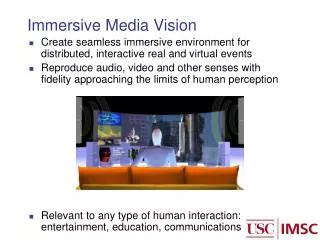
Immersive Subjective Testing Proof of Concept
Video Quality Subjective Testing Psychophysics Can you see a difference?
What is Missing? Usability Immersion
Immersion • Audiovisual • 1 minute SRC • Distractor questions • 35-40 subjects
Speech Quality Test • A1 is AMR narrowband, mode 0 (4.75 kb/s) • A2 is AMR narrowband, mode 7 (12.2 kb/s) • A3 is AMR wideband, mode 1 (8.85 kb/s) • A4 is AMR wideband, mode 8 (24.0 kb/s)
Questions • What topic was this person discussing? Occupation, traveling, family, self, memories, other • How interesting did you find this clip? Intriguing, interesting, neutral, uninteresting, boring • What attracted your attention the most? Message, clothing, face, gestures, manner of speaking • Would you enjoy having a conversation with this person? Very likely, somewhat likely, neutral, unlikely, very unlikely • How would you rate the overall quality of the sound and picture? Excellent, good, fair, poor, bad
Student’s t-test at 95% confidence • Immersive • (A1,A3) and (A1,A4) were statistically different • Voran • all HRCs were statistically different • Ramo • all HRCs are statistically different
Thoughts? Sample Experiments Collaboration