Exploring James Joyce's "Ulysses": Themes, Characters, and Literary Techniques
140 likes | 524 Vues
James Joyce's "Ulysses," published in 1922, delves into the intricacies of ordinary life on June 16, 1904, in Dublin. The narrative follows Leopold Bloom, embodying the common man, alongside his wife Molly and the young Stephen Dedalus. The structure parallels Homer's "Odyssey," transforming struggles into a profound exploration of human experience. Joyce's revolutionary prose, employing stream-of-consciousness and rich symbolism, captures the essence of the human mind. The annual Bloomsday celebration commemorates this masterpiece, tracing Bloom's journey through Dublin while honoring Joyce's literary legacy.


Exploring James Joyce's "Ulysses": Themes, Characters, and Literary Techniques
E N D
Presentation Transcript
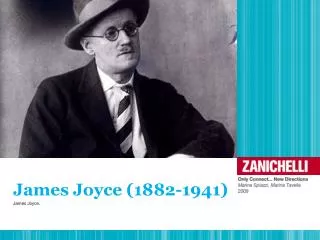
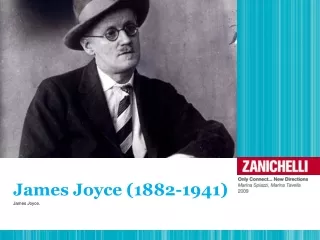
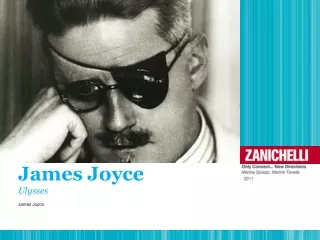
James Joyce Ulysses James Joyce.
James Joyce –Ulysses 1. Ulysses • Published in 1922. • Setting in timea single day, Thursday 16th June, 1904. • The setting in place Dublin. • A detailed account of ordinary life on an ordinary day. • The theme is moral human life means suffering but also struggling to seek the good. Ulysses, London, Egoist Press, 1922 (first English edition, printed in France). OnlyConnect ... New Directions
James Joyce –Ulysses 2. Ulysses: characters • Leopold Bloom Joyce's common man; he stands for the whole of mankind. • Molly Bloom Leopold’s wife; she stands for flesh, sensuality, fecundity. • Stephen Dedalus pure intellect; he embodies every young man seeking maturity. Poster for Sean Walsh’s Bloom (2003) OnlyConnect ... New Directions
James Joyce –Ulysses 3. Ulysses: the relation to Odyssey • Odysseya structural framework for Ulysses. • Characters and events arranged around Homeric model Leopold = Odysseus Molly = Penelope Stephen = Telemachus • Ulyssesis divided into Telemachiad (chapters 1-3) Odyssey (chapters 4-15) Nostos (chapters 16-18) Head of Odysseus from a Greek 2nd century BC marble group representing Odysseus blinding Polyphemus, found at the villa of Tiberius at Sperlonga. OnlyConnect ... New Directions
James Joyce –Ulysses 4. Ulysses: the mythical method • It allowed the parallel with the Odysseyand provided the book with a symbolic meaning. • Homer’s myth used to express the universal inthe particular. • It created a new form of realism. • It was linked to the progress made by: • psychology • ethnology • anthropology OnlyConnect ... New Directions
James Joyce –Ulysses 5. Ulysses: a revolutionary prose The stream of consciousness technique The cinematic technique Dramatic dialogue Juxtaposition of events Question and answers Collage technique The language rich in puns, paradoxes, images, interruptions, symbols, slang expressions; different linguistic registers to give voice to the unspoken activity of the mind. OnlyConnect ... New Directions
James Joyce –Ulysses 6. Ulysses: The Funeral Part III • Use of interior monologue 2 levels of narration. 1st level: actions narrated from the outside neutral point of view. 2nd level: Leopold’s thoughts Bloom’s point of view The action takes place in his mind. There is no difference between past, present and future. Leopold attends a funeral. OnlyConnect ... New Directions
James Joyce –Ulysses 7. Ulysses: Molly’s monologue • Use of extreme interior monologue. • Molly’s thoughts are free to move backwards(“they called it on…”) and forwardsin time (“shall I wear…”). • Complete absence of punctuation and introductions to people and events, spelling and grammar mistakes they give voice to her flow of thoughts. OnlyConnect ... New Directions
James Joyce –Ulysses 8. Ulysses and the Victorian novel OnlyConnect ... New Directions
James Joyce –Ulysses 9. Bloomsday • 16th June. • It is a celebration of James Joyce’s life and masterpiece Ulysses. • During this celebration, Bloom’s route through the streets of Dublin is followed by participants in the festival, with readings along the way. People celebrating Bloomsday in Dublin. • Other locations from Joyce's pages are visited, films are shown and the Theatre Company brings Joyce to the city streets and squares. • This festival goes on for a week. OnlyConnect ... New Directions