Maximizing Sugar Translocation in Plants: Sources, Sinks, and Experiments
Learn about how plants transport sugar from sources to growing parts through translocation. Explore experiments, sap chemistry, and the pressure-flow process. Discover the role of phloem and xylem in synthesizing new cells.


Maximizing Sugar Translocation in Plants: Sources, Sinks, and Experiments
E N D
Presentation Transcript
How the growing parts of the plant are provided with sugar to synthesize new cells
Multiple sources and sinks Developing apex
Girdling experiments Radio active tracer experiments
Aphids http://members.ozemail.com.au/~lblanco/Ap1.htm
Typical Phloem Sap Chemistry Xylem and Phloem Sap Compositionsfrom White Lupine (Lupinus albus) Xylem Sap (mg/l)Phloem Sap (mg/l) Sucrose * Amino acids 700 Potassium 90 Sodium 60 120 Magnesium 27 85 Calcium 17 21 Iron 1.8 9.8 Manganese 0.6 1.4 Zinc 0.4 5.8 Copper Trace 0.4 Nitrate 10 * pH 6.3 7.9 http://forest.wisc.edu/forestry415/INDEXFRAMES.HTM
Sucrose http://www.biologie.uni-hamburg.de/b-online/e16/16h.htm#sucr
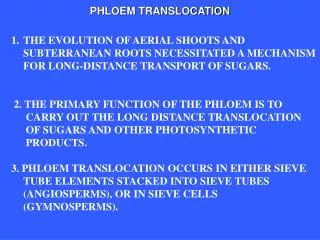
Pressure flow schematic The pressure-flow process Bulk Flow Fig. 30.18
Phloem structure Top
Plasmodesmata Plasmodesmata
Branched plasmodesmata Companion cell Cell wall Sieve element Longitudinal section between cells in the phloem including a branched plasmodesma. (Echium rosulatum petiole)