DNA Structure & Replication Key Terms
This lesson explores the fundamental aspects of DNA (deoxyribonucleic acid), focusing on its double-stranded structure and its role in storing genetic information crucial for cellular functions, growth, and division. Key components include nucleotides, which consist of a sugar, phosphate group, and nitrogen base. The structure resembles a twisted ladder, with nitrogenous bases (adenine, thymine, cytosine, guanine) forming the rungs. This foundational knowledge is vital for understanding cellular replication and genetics.

DNA Structure & Replication Key Terms
E N D
Presentation Transcript
DNA Structure & Replication Key Terms CSCOPE Unit 06 Lesson 01
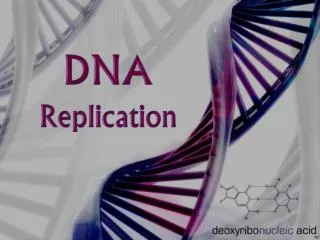
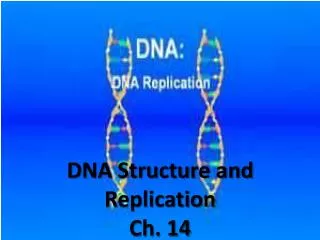
DNA • Deoxyribonucleic acid • Double-stranded nucleic acid (double helix shape—like a twisted ladder) • Contains genetic information for cell functions, growth, and division.
Nucleotide • Basic building block of nucleic acids • Three parts: • Sugar • Phosphate group • Nitrogen base
Deoxyribose Sugar • Sugar component in the backbone of DNA • 5-Carbon sugar
Phosphate Group • Binds with sugar in DNA backbone • Phosphorous attached to four oxygen atoms
Nitrogen Base Pairs • Nitrogen base pairs form the “rungs” of the DNA structure. • Adenine • Purine base that pairs with thymine • Thymine • Pyrimidine base that pairs with adenine • Cytosine • Pyrimidine base that pairs with guanine • Guanine • Purine base that pairs with cytosine
Double Helix Nitrogenous Bases (A-T) and (C-G) Sugar Phosphate Backbone