Download
1 / 12
120 likes | 252 Vues
This presentation delves into the life and work of poet Li-Young Lee, born on August 19, 1957, in Jakarta, Indonesia. With a rich heritage—from his mother, a daughter of the first president of the Republic of China, to his father, Mao Zedong's personal doctor—Lee's poetry embodies profound themes of fatherhood, childhood experiences, and cultural contrasts between American and Chinese traditions. His craft is characterized by metaphors, sensory imagery, and a unique style that intertwines simplicity with deep emotional resonance, making Lee a distinctive voice in contemporary poetry.

E N D
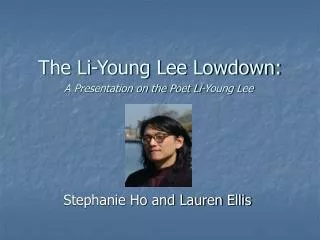
The Li-Young Lee Lowdown: A Presentation on the Poet Li-Young Lee Stephanie Ho and Lauren Ellis
Biographical Info • Was Born August 19, 1957, in Jakarta, Indonesia • Has great pride in his Chinese heritage • Mother was daughter of 1st president of Republic of China • Father personal doctor to Mao Zedong • Father was one year political prisoner • This led to the family being on the run • Ended up in America around the time Lee was 7
Influences on Lee’s Work • Childhood spent on the run • Grew up in American culture • Close relationship with his father • His father went blind
Lee’s Style • Strength • Silence • Simplicity • Inspired by classical Chinese poets • Structure • Irregular stanza organization • No specific rhyming pattern
Themes & Motifs • Everyday/trivial things • Fatherhood and childhood • Differences b/w American and Chinese culture • Fruit (Persimmons and Blossoms) • Fire, light, ice…
While the long grain is softeningin the water, gurglingover a low stove flame, beforethe salted Winter Vegetable is slicedfor breakfast, before the birds,my mother glides an ivory combthrough her hair, heavyand black as calligrapher's ink.She sits at the foot of the bed.My father watches, listens forthe music of combagainst hair. My mother combs,pulls her hair backtight, rolls itaround two fingers, pins itin a bun to the back of her head.For half a hundred years she has done this.My father likes to see it like this.He says it is kempt. But I knowit is because of the waymy mother's hair fallswhen he pulls the pins out.Easily, like the curtainswhen they untie them in the evening. “Early in the Morning”
Literary Criticism • Generally: • Emphasizes his Chinese heritage • Based on turbulent childhood memories • Most poems concern his father – a strong presence in Lee’s life. • Expert use of metaphors • Formal grace • Powerful • Sensory • “…graceful layering of short, declarative phrases…” • The Weight of Sweetness: • “‘Surprising’ structure”: abstract concrete • “Reverse” fairytale
Literary Criticism • The City in Which I Love You (Publisher’s Weekly): • “Weaves a remarkable web of memory from the multifarious fibers of his experience.” • “Images are economical yet fluid, and his language is often startling for its brave honesty.” • “A kaleidoscope of dreams and nightmares…” • Persimmons • “…reaches into the murky depths of memory to salvage cherishable characteristics of his parents and their culture…”
Agree • Master use of tone “graceful layering” • Father & childhood had large impact • Metaphors • Memories • Powerful, sensory, formal grace…
Disagree • Style cannot be explained by heritage • Didn’t know parent’s heritage well • Not always short, declarative sentences
From blossoms comesthis brown paper bag of peacheswe bought from the boyat the bend in the road where we turned towardsigns painted Peaches.From laden boughs, from hands,from sweet fellowship in the bins,comes nectar at the roadside, succulentpeaches we devour, dusty skin and all,comes the familiar dust of summer, dust we eat. O, to take what we love inside,to carry within us an orchard, to eatnot only the skin, but the shade,not only the sugar, but the days, to holdthe fruit in our hands, adore it, then bite intothe round jubilance of peach.There are days we liveas if death were nowherein the background; from joyto joy to joy, from wing to wing,from blossom to blossom toimpossible blossom, to sweet impossible blossom. “From Blossoms”
Conclusions • Lee’s style is unique due to the fact that he is the second generation of Asian-American. • Poems center around memories, nature, differences in culture. • Strong voice, simplicity in style. • Metaphors play huge part in many of his poems.