
SlideServe
Menu
Préférences
© SlideServe · v2026

Binary Stars in Palomar Observatory's Catalog

mast avatar
8 diapositives · 142 Views · Jan 04, 2020

Explore the classification of star systems within 10 parsecs, including singles, doubles, triples, and more. Learn about visual and spectroscopic binaries, Kepler's laws, Doppler shift, and eclipsing binaries.
Binary Stars in Palomar Observatory's Catalog - slide 1
01 / 8Binary Stars in Palomar Observatory's Catalog
1 / 17

Télécharger la présentation

Binary Stars in Palomar Observatory's Catalog
Une image / un lien ci-dessous est fourni (tel quel) pour télécharger la présentation

Politique de téléchargement : le contenu du site vous est fourni TEL QUEL pour votre information et votre usage personnel ; il ne peut être vendu, concédé sous licence ni partagé sur d’autres sites sans l’accord de son auteur.Le contenu vous est fourni TEL QUEL, pour votre information et votre usage personnel uniquement. Téléchargez la présentation en cliquant sur ce lien. Lors du téléchargement, si vous ne parvenez pas à télécharger une présentation, l’éditeur a peut-être supprimé le fichier de son serveur.Pendant le téléchargement, si vous ne parvenez pas à obtenir une présentation, le fichier a peut-être été supprimé par l’éditeur.

F I N

Plus de contenu associé

Transcription de la présentation
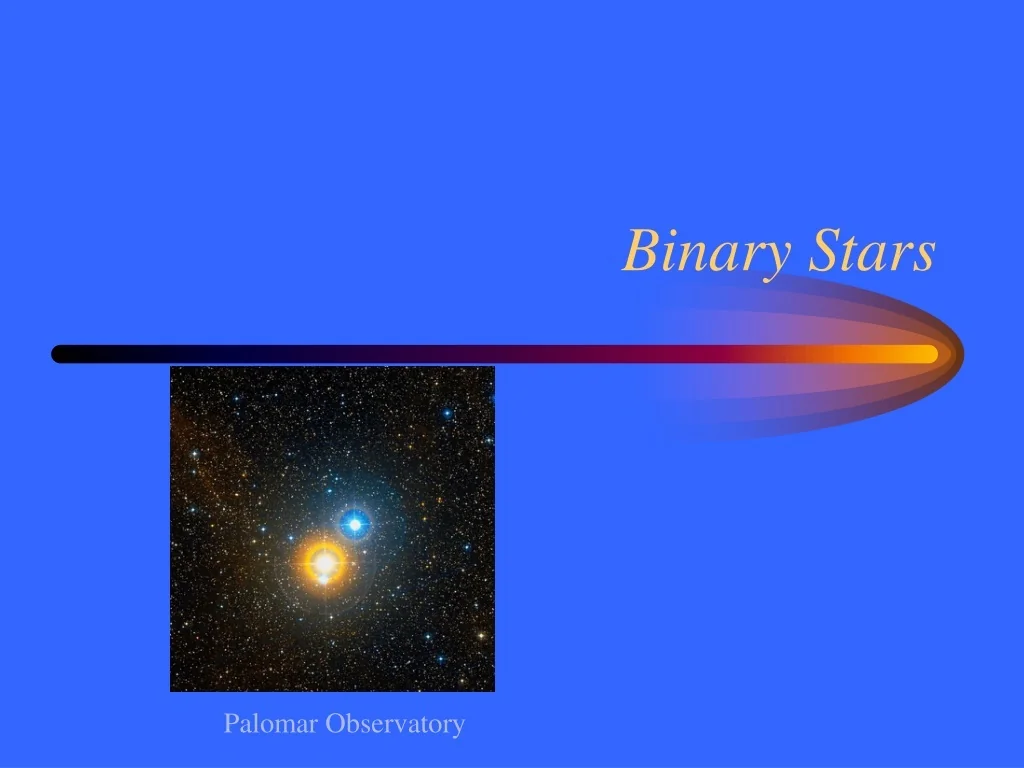
  1. Binary Stars Palomar Observatory

  2. Star systems within 10 Pc have been cataloged by RECONS (Jan 2012). Total systems 259 Singles 185 Doubles 55 Triples 15 Quadruples 3 Quintuples 1 Star Systems • Star systems can involve both single and multiple stars. • Double stars common

  3. Visual Binaries • Visual binaries occur when the centers are separated by more than 1”. • Atmospheric effects • Apparent binaries occur when two stars are near the same coordinates but not close in space.

  4. Orbit • Kepler’s third law is used as compared to the sun. • Mass M in solar masses • Period P in years • Semimajor axis a in AU • The semimajor axis depends on knowing the distance and tilt.

  5. Mass • Gravity attracts each star towards the center of mass. • Larger mass closer to the center • Separate masses come from observing the center of mass. Magnified to show gravitational pull

  6. Spectroscopic Binaries • As binary stars orbit each other their radial motion changes. • Doppler shift • Spectral lines shift red then blue • The period of time to make the shift and back is one orbital revolution.

  7. Some stars are too close to separate with telescopes or spectra. Fluctuating spectrum Fluctuating light Periodic eclipses diminish the total light. Eclipsing Binaries

  8. Stellar Sizes • The length of the eclipse is related to the size of the star. • A few close, big stars can be seen in a telescope as measurable disks. • Speckle interferometry Betelgeuse with infrared interferometry X. Haubois, Observatorie de Paris