Photosynthesis
140 likes | 274 Vues
Photosynthesis is a vital process through which plants convert light energy into chemical energy, primarily during light-dependent reactions in the thylakoid membranes. Here, light absorbed by chlorophyll leads to the production of ATP and NADPH, while water is split, releasing oxygen. The accompanying light-independent reactions use ATP and NADPH to convert carbon dioxide into glucose. This overview covers the key components, including photosystems, cyclic and noncyclic electron transport, and the overall significance of photosynthesis in energy transformation.


Photosynthesis
E N D
Presentation Transcript
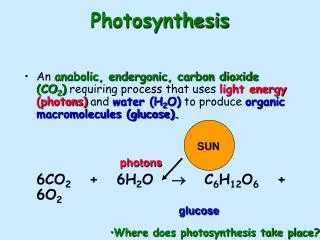
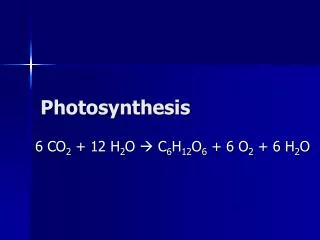
Photosynthesis 6 CO2 + 12 H2O C6H12O6 + 6 O2 + 6 H2O
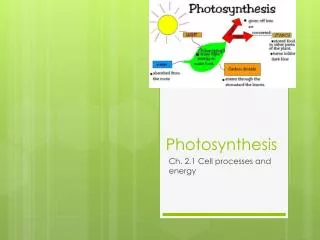
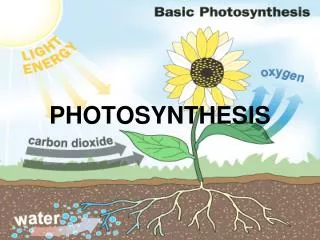
Light-Dependent Reactions Light captured ATP and NADPH produced H2O is split O2 is released Light-Independent Reactions ATP and NADPH in CO2 in Carbohydrates produced Overview of Photosynthesis
Light-Dependent Reactions • Take place in the thylakoid membranes • Light is absorbed by chlorophyll a and/or accessory pigments • These pigments are attached to pigment-binding proteins and arranged in an antenna system
When energy absorbed the energy is passed from one pigment molecule to another • Energy absorbed by pigments is transferred to a reaction center • pair of cholorophyll a molecules • the reaction center e- moves to a higher energy level • This e- is transferred to primary e- receptor
Photosystems • There are 2 types of photosynthetic units: • Photosystem I • Photosystem II • Photosytem I rxn center is P700 • Photosytem II rxn center is P680
Cyclic Electron Transport • Simplest light-dependent reaction • Only involves PSI • Light energy is transferred to P700 reaction center which gives up 2 e- • e- reduces primary e- receptor
From primary e- receptor, e- enters ETC • As e- pass down ETC, H+ are pumped across membrane into lumen of thylakoid • ATP is generated by chemiosmosis • Photophosphorylation • e- is channeled back to reaction center from which it was lost
Noncyclic Electron Transport • Involves PSI and PSII • Produces both ATP and NADPH • PSI absorbs energy & passes e- to ETC • End of this ETC the e- reduces NADP+ in presence of enzyme
PSII becomes activated and gives off e- from P680 • E- goes to primary e- receptor and down ETC to PSI to replace its lost e- • As e- moves from PSII to PSI, H+ are pumped across membrane • E- lost from PSII are replaced by photolysis • Splitting of H2O into 2 H+, 2 e- and oxygen http://www.stolaf.edu/people/giannini/flashanimat/metabolism/photosynthesis.swf
http://www.cst.cmich.edu/users/baile1re/bio101fall/enzphoto/photoanima.htm#http://www.cst.cmich.edu/users/baile1re/bio101fall/enzphoto/photoanima.htm#
Let’s Review… • Main outputs of light-dependent rxns are: • NADPH (from noncyclic electron transport) • ATP (from cyclic and noncylic transport) • O2 – from photolysis • http://highered.mcgraw-hill.com/sites/0072437316/student_view0/chapter10/animations.html#