Download
1 / 4
40 likes | 149 Vues
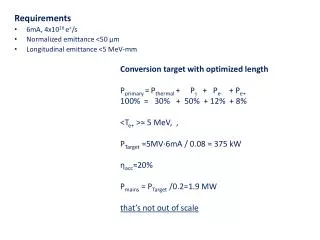
This document discusses the requirements and challenges in positron production, outlining parameters such as current at 6 mA, normalized emittance under 50 μm, and longitudinal emittance below 5 MeV-mm. Various solutions for emittance reduction are presented, including phase space cutting and acceleration to 1 GeV, with a focus on minimizing multiple scattering in production targets. The document references previous studies and highlights the need for reconsideration with state-of-the-art technologies, including advanced laser systems and X-ray Free Electron Lasers (FELs).

E N D
Requirements • 6mA, 4x10¹⁶ e+/s • Normalized emittance <50 μm • Longitudinal emittance <5 MeV-mm Conversion target with optimized length Pprimary=Pthermal+ P + Pe- + Pe+ 100% = 30% + 50% + 12% + 8% <Te+ >≈ 5 MeV, , PTarget =5MV∙6mA / 0.08 = 375 kW ηacc≈20% Pmains = PTarget /0.2=1.9 MW that’s not out of scale
Emittance of all positrons from target • εN≈ 1-10 mm • required εN=0.05 mm • factor 100 emittance reduction required • Solution 1 • cut phase space, needs unrealistic increase of primary beam power • Solution 2 • collect all positrons, accelerate to 1 GeV and Log(100) ≈ 5 damping times • PRF=1GeV ∙5mA∙5/0.2=150MW • Solution 3 • produce positrons in smaller phase space volume • Inherent transverse emittance from is pair production is small. • The large phase space volume comes from multiple scattering in production target! • Pair production from relativistic electrons in strong laser field • no solid target, no multiple scattering !
SLAC-Pub-8063, 1999 and Phys.Rev. D Studies of Nonlinear QED in collisions of 46.6 GeV Electrons with Intense Laser Pulses many authors To be reconsidered with 2011 state of the art TiSa lasers and X-ray FELs !
0.1 0.1 to be checked 5