Download
1 / 12
140 likes | 291 Vues
Explore the intricate workings of excitable cells, synaptic contacts, and ion channels in this comprehensive study of biophysics. Learn how action potentials are generated, propagated, and measured through advanced techniques like patch clamping.

E N D
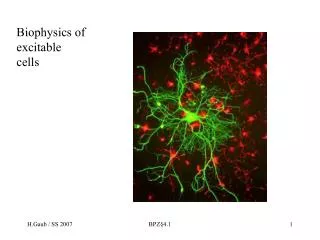
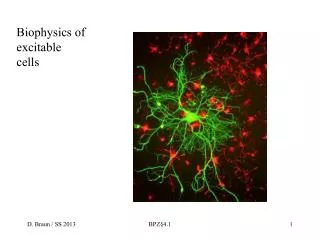
Biophysics of excitable cells BPZ§4.1
Multiple exitatory and inhibitory synaptic contacts allow complex neuronal interconnects BPZ§4.1
Cell-Semiconductor-Hybrids: Neuron on the Chip More: Fromherz MPI Martinsried BPZ§4.1
The electrical activity of neurons results from the opening and closing of specific ion-channels proteins in the neuron plasma membrane BPZ§4.1
Voltage-gated cation channels generate action potentials BPZ§4.1
Membrane depolarizations spread passively only short distances BPZ§4.1
Action potentials are propagated unidirectionally without diminution Movements of only a few Na+ and K+ ions generate the action potential BPZ§4.1
Patch clamps permit measurement of ion movements through single channels BPZ§4.1
Current flux through individual voltage-gated channels determined by patch clamping of muscle cells BPZ§4.1
All five subunits in the nicotinic acetylcholine receptor contribute to the ion channel BPZ§4.1