Binomial Random Variable Approximations and Stirling’s Formula
310 likes | 330 Vues
Explore the Normal and Poisson Approximations in Binomial Random Variables using Stirling’s Formula, with examples on lottery odds, space mission risk, and conditional probability scenarios.


Binomial Random Variable Approximations and Stirling’s Formula
E N D
Presentation Transcript
Binomial Random Variable Approximations,Conditional Probability Density Functionsand Stirling’s Formula
Let X represent a Binomial r.v ,Then from • for large n. In this context, two approximations are extremely useful.
The Normal Approximation (Demoivre-Laplace Theorem) • Suppose with p held fixed. Then for k in the neighborhood of np, we can approximate • And we have: • where
As we know, • If and are within with approximation: • where • We can express this formula in terms of the normalized integral • that has been tabulated extensively.
Example • A fair coin is tossed 5,000 times. • Find the probability that the number of heads is between 2,475 to 2,525. • We need • Since n is large we can use the normal approximation. • so that and • and • So the approximation is valid for and Solution
Example - continued • Here, • Using the table,
The Poisson Approximation • For large n, the Gaussian approximation of a binomial r.v is valid only if p is fixed, i.e., only if and • What if is small, or if it does not increase with n? • for example, as such that is a fixed number.
The Poisson Approximation • Consider random arrivals such as telephone calls over a line. • n: total number of calls in the interval • as we have • Suppose • Δ: a small interval of duration
The Poisson Approximation • p: probability of a single call (during 0 to T) occurring in Δ: • as • Normal approximation is invalid here. • Suppose the interval Δ in the figure: • (H) “success” : A call inside Δ, • (T ) “failure” : A call outside Δ • : probability of obtaining k calls (in any order) in an interval of duration Δ ,
The Poisson Approximation • Thus, the Poisson p.m.f
Example: Winning a Lottery • Suppose • two million lottery tickets are issued • with 100 winning tickets among them. • a) If a person purchases 100 tickets, what is the probability of winning? Solution The probability of buying a winning ticket
Winning a Lottery - continued • X: number of winning tickets • n: number of purchased tickets , • P: an approximate Poisson distribution with parameter • So, The Probability of winning is:
Winning a Lottery - continued • b) How many tickets should one buy to be 95% confident of having a winning ticket? • we need • But or • Thus one needs to buy about 60,000 tickets to be 95% confident of having a winning ticket! Solution
Example: Danger in Space Mission • A space craft has 100,000 components • The probability of any one component being defective is • The mission will be in danger if five or more components become defective. • Find the probability of such an event. • n is large and p is small • Poisson Approximation with parameter Solution
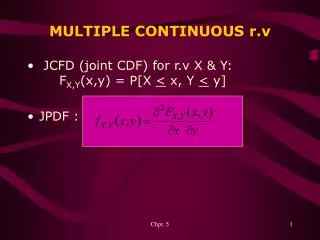
Conditional Probability Density Function • Further, • Since for
1 1 1 1 (b) (a) Example • Toss a coin and X(T)=0, X(H)=1. • Suppose • Determine • has the following form. • We need for all x. • For so that • and Solution
1 1 Example - continued • For so that • For and
Example • Given suppose Find • We will first determine • For so that • For so that Solution
(b) (a) Example - continued • Thus • and hence
Example • Let B represent the event with • For a given determine and Solution
Example - continued • For we have and hence • For we have and hence • For we have so that • Thus,
Conditional p.d.f & Bayes’ Theorem • First, we extend the conditional probability results to random variables: • We know that If is a partition of S and B is an arbitrary event, then: • By setting we obtain:
Conditional p.d.f & Bayes’ Theorem • Using: • We obtain: • For ,
Conditional p.d.f & Bayes’ Theorem • Let so that in the limit as • or • we also get • or (Total Probability Theorem)
Bayes’ Theorem (continuous version) • using total probability theorem in • We get the desired result
Example: Coin Tossing Problem Revisited • probability of obtaining a head in a toss. • For a given coin, a-priori p can possess any value in (0,1). • : A uniform in the absence of any additional information • After tossing the coin n times, k heads are observed. • How can we update this is new information? • Let A= “k heads in n specific tosses”. • Since these tosses result in a specific sequence, • and using Total Probability Theorem we get Solution
Example - continued • The a-posteriori p.d.f represents the updated information given the event A, • Using • This is a beta distribution. • We can use this a-posteriori p.d.f to make further predictions. • For example, in the light of the above experiment, what can we say about the probability of a head occurring in the next (n+1)th toss?
Example - continued • Let B= “head occurring in the (n+1)th toss, given that k heads have occurred in n previous tosses”. • Clearly • From Total Probability Theorem, • Using (1) in (2), we get: • Thus, if n =10, and k = 6, then • which is more realistic compare to p = 0.5.





![Theorem 6.6: Let [G; ] be a group and let a and b be elements of G. Then](https://cdn3.slideserve.com/5891401/slide1-dt.jpg)